
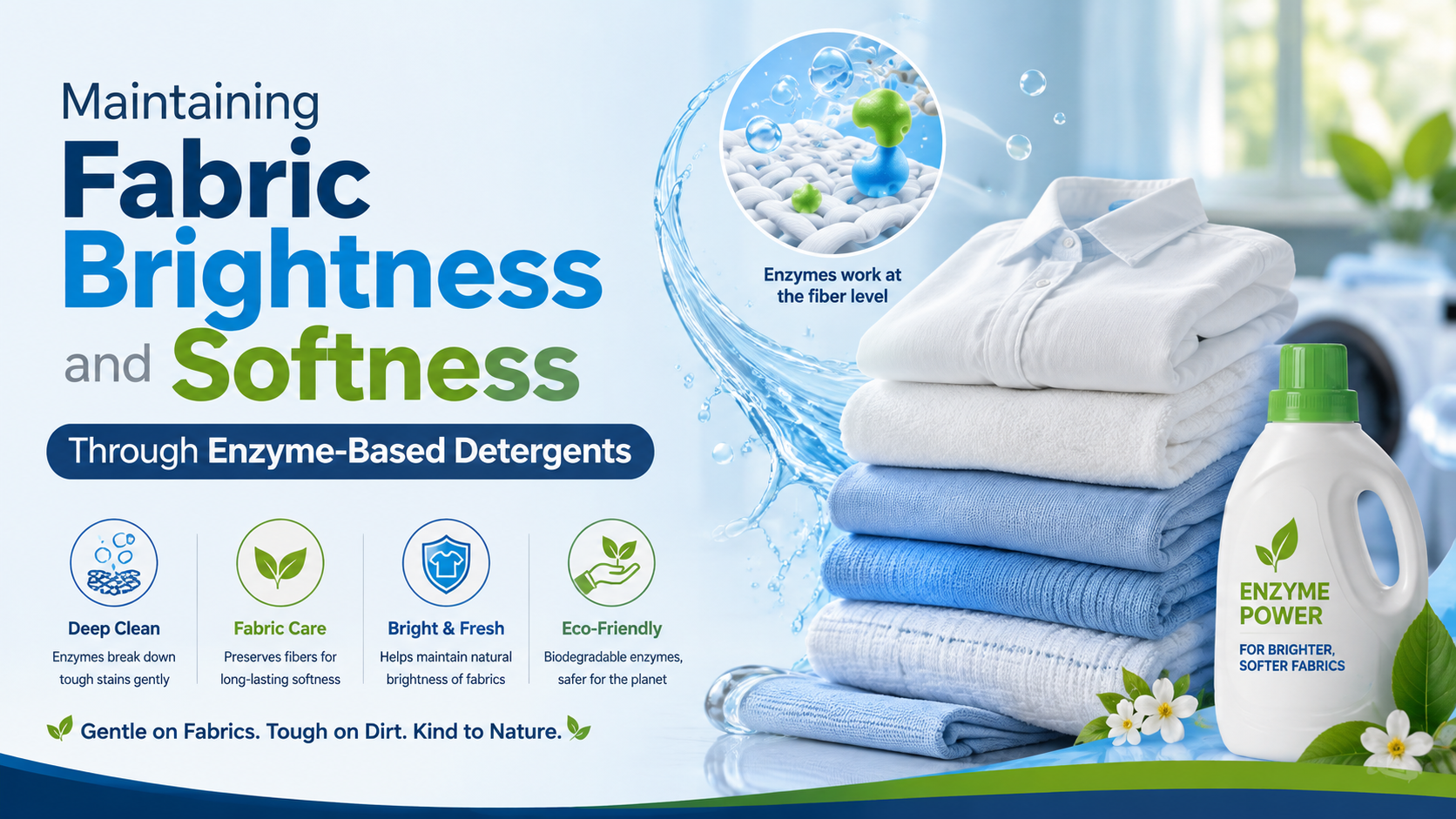
The global detergent industry has evolved significantly over the past two decades, driven by changing consumer expectations, advances in textile manufacturing, and increasing emphasis on sustainability. Today’s consumers expect detergents to deliver excellent stain removal while preserving fabric colour, softness and durability, even after repeated washing. At the same time, detergent manufacturers face growing pressure to reduce energy consumption, minimise reliance on harsh chemicals and develop formulations that meet increasingly stringent environmental standards.
Industrial enzyme technology has become one of the most important innovations supporting these objectives. By incorporating specialised enzymes into detergent formulations, manufacturers can improve cleaning efficiency while helping maintain the appearance and feel of fabrics. Unlike conventional chemical agents that often require higher washing temperatures or aggressive formulations, enzymes perform highly selective biochemical reactions that remove stains without unnecessarily damaging textile fibres.
The success of enzyme-based detergents reflects the broader role of industrial enzymes across modern manufacturing. Similar technologies are widely used in food processing, dairy production, tea processing, commercial baking, textile finishing, animal nutrition, water treatment and sugar manufacturing, where they improve productivity, product quality and process sustainability.
This article explores the science behind enzyme-based detergents, how they contribute to fabric brightness and softness, and the broader significance of industrial enzymes across multiple industries.
The Evolution of Modern Detergent Technology
Traditional detergent formulations relied primarily on surfactants, builders, and chemical bleaching agents to remove dirt and stains. While effective in many applications, these formulations often required elevated washing temperatures and repeated mechanical action to achieve satisfactory cleaning performance.
Modern detergent technology increasingly incorporates biological catalysts that complement conventional ingredients.
These enzyme systems enable manufacturers to develop products capable of:
- Improved stain removal
- Lower temperature washing
- Better fabric care
- Enhanced colour retention
- Reduced energy consumption
- Improved washing efficiency
The integration of enzyme technology has fundamentally changed the way detergents perform across both household and industrial laundry applications.
Understanding Enzymes in Detergent Formulations
Enzymes are naturally occurring proteins that accelerate highly specific biochemical reactions.
Unlike traditional chemical cleaning agents, enzymes target particular stain components without affecting surrounding fabric fibres.
Modern detergent formulations commonly contain combinations of:
- Proteases
- Amylases
- Lipases
- Cellulases
- Mannanases
- Pectinases (in specialised applications)
Each enzyme performs a distinct cleaning function, allowing manufacturers to formulate products capable of addressing multiple stain types simultaneously.
How Enzyme-Based Detergents Work
The effectiveness of enzyme detergents lies in their selective catalytic activity.
The cleaning process generally involves several stages.
1. Contact with Fabric
During washing, detergent enzymes come into contact with stains attached to textile fibres.
Different enzymes recognise different organic materials present on fabrics.
2. Breakdown of Complex Molecules
Each enzyme hydrolyses specific stain components.
Examples include:
- Proteases degrade protein-based stains.
- Amylases break down starch residues.
- Lipases hydrolyse fats and oils.
- Cellulases modify surface cellulose fibres.
These reactions convert complex stain molecules into smaller compounds that are more easily removed by surfactants.
3. Stain Removal
Once enzymatic hydrolysis has occurred, loosened stain particles are suspended in the wash solution and removed during rinsing.
This allows effective cleaning with less dependence on aggressive chemical action.
The Role of Cellulase in Maintaining Fabric Brightness
Among detergent enzymes, cellulase plays a particularly important role in preserving the appearance of cotton and cellulose-based fabrics.
Repeated washing gradually creates microscopic fibre fibrils on fabric surfaces.
These tiny fibres:
- Scatter light
- Trap dirt
- Cause dullness
- Reduce colour brightness
Cellulase gently removes these loose surface fibrils without significantly affecting the integrity of the fabric.
Benefits include:
- Improved colour brightness
- Enhanced fabric smoothness
- Reduced pilling
- Better appearance after repeated washing
This process is commonly referred to as fabric renewal.
How Enzymes Help Preserve Fabric Softness
Fabric softness is influenced by both fibre condition and residue accumulation.
Enzyme technology contributes by:
- Removing protein deposits
- Eliminating starch residues
- Reducing fibre roughness
- Minimising surface fibrillation
Because enzyme action is highly selective, textile fibres experience less unnecessary damage than they might with harsher chemical treatments.
The result is improved fabric feel throughout the garment’s lifespan.
Benefits of Enzyme-Based Detergent Technology
The incorporation of industrial enzymes offers numerous advantages for detergent manufacturers and end users.
1. Superior Cleaning Performance
Specialised enzyme blends effectively remove:
- Food stains
- Dairy residues
- Blood stains
- Grass stains
- Oils and grease
- Starch deposits
This improves overall cleaning efficiency across a wide range of fabrics.
2. Effective Low-Temperature Washing
Many modern enzyme formulations remain highly active at moderate washing temperatures.
This supports:
- Lower household energy consumption
- Reduced environmental impact
- Improved fabric protection
3. Extended Fabric Life
Gentler cleaning mechanisms contribute to:
- Reduced fibre damage
- Improved colour retention
- Better garment appearance
- Longer textile lifespan
4. Improved Sustainability
Enzyme technology supports cleaner detergent formulations by contributing to:
- Lower energy requirements
- Reduced chemical dependency
- Improved resource efficiency
- Enhanced environmental performance
Key Enzymes Used in Detergent Manufacturing
1. Proteases
Proteases hydrolyse protein-based stains such as:
- Blood
- Egg
- Milk
- Sweat
- Food residues
2. Amylases
Amylases remove starch-containing stains from foods including:
- Rice
- Pasta
- Potatoes
- Sauces
- Bakery products
3. Lipases
Lipases target:
- Cooking oils
- Butter
- Grease
- Cosmetic oils
These enzymes improve fat removal even under lower washing temperatures.
4. Cellulases
Cellulases contribute to:
- Fabric renewal
- Brightness retention
- Softness improvement
- Reduced pilling
Factors Influencing Enzyme Performance
Several process variables influence detergent enzyme activity.
1. Temperature
Modern enzymes are formulated to perform effectively across typical domestic and industrial washing temperatures.
2. pH
Enzyme formulations are carefully designed to remain active within the pH range of detergent systems.
3. Washing Time
Adequate contact time allows enzymes to complete hydrolysis before the rinse cycle.
4. Formulation Stability
Successful detergent development requires maintaining enzyme stability throughout product storage and use.
Sustainability and the Future of Laundry Care

Environmental considerations continue to influence detergent innovation.
Enzyme technology contributes to sustainability by supporting:
- Reduced washing temperatures
- Lower energy consumption
- Improved biodegradability
- Reduced chemical usage
- Extended garment life
- Lower environmental impact
These advantages align with the growing emphasis on sustainable household and industrial cleaning solutions.
Industrial Enzymes Beyond Detergent Applications
The success of detergent enzymes reflects the broader contribution of industrial biotechnology across numerous manufacturing sectors.
1. Enzymes for Tea Processing
Tea production depends upon carefully controlled biochemical transformations.
Enzyme technology supports:
- Flavour development
- Colour formation
- Aroma enhancement
- Controlled oxidation
- Improved product consistency
These improvements assist manufacturers in producing premium-quality teas.
2. Enzymes for Baking
Commercial baking relies extensively on enzyme technology.
Applications include:
- Dough conditioning
- Increased loaf volume
- Improved crumb softness
- Better dough handling
- Extended freshness
Enzymes improve production consistency while reducing reliance on chemical additives.
3. Enzymes for Dairy Processing
Industrial enzymes support numerous dairy applications including:
- Lactose hydrolysis
- Cheese manufacture
- Protein modification
- Texture enhancement
- Yield optimisation
These technologies improve both product quality and processing efficiency.
4. Enzymes for the Textile Industry
Textile manufacturing itself has become one of the largest industrial users of enzyme technology.
Applications include:
- Desizing
- Bio-polishing
- Denim finishing
- Fabric softening
- Fibre preparation
Many of these processes complement the benefits delivered later through enzyme-based detergents by helping preserve fibre quality throughout the textile lifecycle.
5. Enzymes for the Feed Industry
Feed enzymes improve nutrient utilisation by breaking down complex feed ingredients.
Benefits include:
- Improved digestibility
- Better feed conversion
- Reduced nutrient losses
- Enhanced livestock productivity
These improvements contribute to more sustainable animal agriculture.
6. Enzymes for Water Treatment
Industrial wastewater treatment increasingly incorporates enzyme technology.
Applications include:
- Organic matter degradation
- Sludge reduction
- Biofilm management
- Wastewater treatment
- Odour control
These biological solutions improve treatment efficiency while reducing environmental impact.
7. Enzymes for Sugar Mills
Industrial enzyme technology also supports sugar manufacturing through:
- Juice clarification
- Improved extraction
- Reduced viscosity
- Better filtration
- Increased sugar recovery
- Enhanced process stability
These improvements contribute to higher operational efficiency throughout sugar production.
Future Developments in Industrial Enzyme Technology
Advances in biotechnology continue to improve the capabilities of industrial enzymes.
Current areas of innovation include:
- Higher enzyme stability
- Improved catalytic efficiency
- Enhanced compatibility with modern formulations
- Broader operating conditions
- Tailor-made enzyme blends
- Greater sustainability performance
As research continues, enzyme technology is expected to further improve industrial efficiency while supporting cleaner manufacturing processes.
The Strategic Role of Enzymes in Sustainable Manufacturing
Industrial enzymes have become strategic tools for manufacturers seeking to balance operational efficiency with environmental responsibility. Their ability to catalyse highly specific reactions enables industries to reduce resource consumption while maintaining product performance and quality.
Across sectors, enzyme technology supports:
- Improved manufacturing efficiency
- Lower energy consumption
- Better utilisation of raw materials
- Reduced environmental footprint
- Greater process consistency
- Enhanced product quality
These advantages position enzymes as an essential component of modern industrial innovation.
Conclusion
Enzyme-based detergents have transformed modern laundry care by combining effective stain removal with improved fabric protection. Through the use of specialised enzymes such as proteases, amylases, lipases and cellulases, manufacturers can develop detergent formulations that help maintain fabric brightness, preserve softness and extend textile lifespan while reducing dependence on harsh chemical treatments. Their ability to deliver excellent cleaning performance at lower washing temperatures also supports greater energy efficiency and more sustainable household and industrial laundry practices.
The importance of industrial enzymes extends far beyond detergent manufacturing. Similar technologies continue to improve tea processing, commercial baking, dairy production, textile finishing, animal nutrition, water treatment and sugar manufacturing by enhancing process efficiency, supporting product quality and reducing environmental impact across a wide range of industries.
Biolaxi Enzymes supports these evolving industrial requirements through a comprehensive portfolio of specialised enzyme solutions designed for detergent formulations and diverse industrial applications. By combining technical expertise, consistent product quality and application-focused innovation, Biolaxi Enzymes helps manufacturers optimise product performance, improve process efficiency and achieve sustainable manufacturing objectives across multiple sectors.