
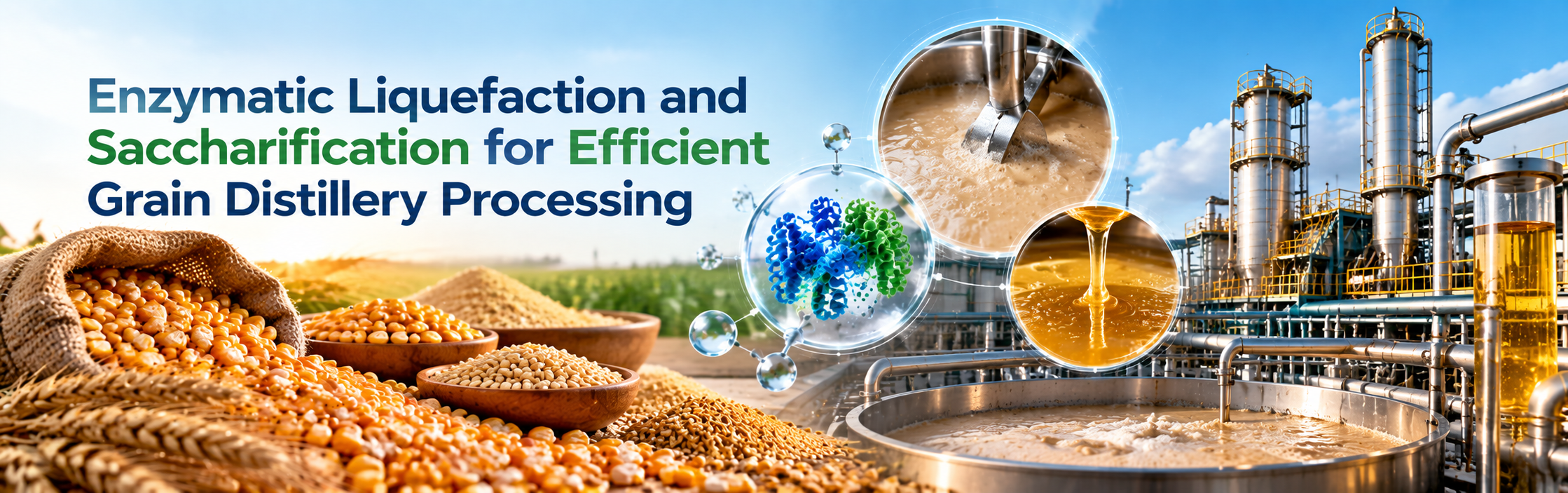
Grain-based distilleries depend on the efficient conversion of starch into fermentable sugars before yeast can convert those sugars into ethanol. Unlike simple sugars, starch cannot be directly fermented by conventional distillery yeast. It must first be structurally opened and hydrolysed through a sequence of processing stages. Enzymatic liquefaction and saccharification are therefore central to the economics and operational reliability of grain distillery production. Alpha-amylase is primarily used during liquefaction to break down gelatinised starch and reduce viscosity, while glucoamylase subsequently converts dextrins and oligosaccharides into glucose that can be fermented. This enzymatic route has become a core element of modern starch-to-ethanol processing because it enables controlled hydrolysis and can offer advantages over older acid-hydrolysis approaches.
For distillery operators, however, enzyme selection is not simply about converting starch. The quality of hydrolysis affects downstream fermentation, alcohol yield, process stability, energy consumption and overall plant efficiency. Understanding how liquefaction and saccharification work, where process losses can occur and how enzyme systems can be optimised is therefore important for both technical and commercial decision makers.
The Starch-to-Ethanol Conversion Chain
Grain distilleries commonly use starch-rich raw materials such as maize, wheat, rice, sorghum and other cereals. These grains contain starch in granular form, with the exact composition and physical properties varying according to the raw material and its processing history.
The overall conversion pathway can be simplified as:
Starch-rich grain → gelatinisation → liquefaction → saccharification → fermentation → distillation → ethanol
Each stage prepares the material for the next.
The first major challenge is that starch exists as large, complex polymers of glucose. These include amylose, which is predominantly linear, and amylopectin, which has a highly branched structure.
Yeast cannot efficiently use these long starch molecules directly. Enzymatic hydrolysis is therefore required to produce smaller carbohydrates and ultimately glucose.
The efficiency of this conversion has a direct bearing on fermentation because insufficient starch hydrolysis leaves fermentable potential unrealised. Research on fuel ethanol production identifies starch hydrolysis efficiency as a critical factor affecting the overall conversion of starch into ethanol.
Why Gelatinisation Is Necessary Before Liquefaction
Before alpha-amylase can work efficiently on starch, the starch granules generally need to undergo gelatinisation.
During heating in the presence of water, starch granules absorb moisture, swell and undergo structural changes. This results in a much more accessible and highly viscous starch suspension.
Gelatinisation is important because it makes starch more accessible to enzymes, but it also introduces a process challenge: the resulting slurry can become extremely viscous.
High viscosity can affect:
- Mixing efficiency
- Heat transfer
- Pumping
- Agitation
- Enzyme distribution
- Process throughput
- Equipment loading
The role of liquefaction is therefore particularly important because it begins breaking down these large starch molecules and reduces viscosity.
A review of starch-based ethanol production describes gelatinisation as producing a viscous suspension, followed by liquefaction, in which starch is partially hydrolysed and viscosity is reduced.
Alpha-Amylase: The Main Catalyst in Liquefaction
Alpha-amylase is an endo-acting enzyme that hydrolyses internal alpha-1,4 glycosidic bonds in starch molecules.
Instead of converting the entire starch molecule directly into glucose, it fragments the long chains into shorter dextrins and oligosaccharides.
The simplified reaction is:
Starch → dextrins + shorter-chain carbohydrates
One of the most important outcomes is a substantial reduction in viscosity.
This makes the mash easier to handle and prepares the carbohydrate material for the next stage of enzymatic hydrolysis.
Industrial distilleries often use thermostable alpha-amylases because liquefaction is carried out under relatively demanding thermal conditions. A suitable enzyme must maintain useful activity at the temperatures and pH encountered in the process while providing adequate substrate conversion. The use of thermostable microbial alpha-amylases is well established in large-scale starch-processing applications.
Understanding Liquefaction as a Process-Control Stage
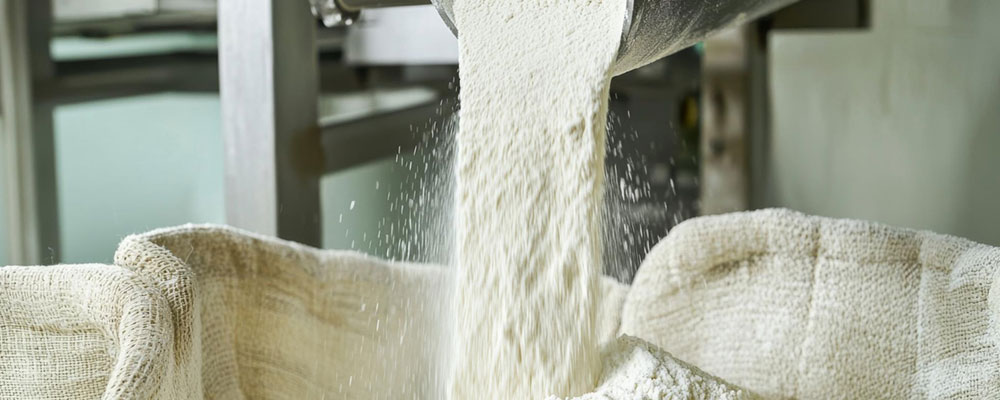
Liquefaction should not be viewed simply as the addition of an enzyme to hot starch.
It is a controlled process involving interactions between:
- Starch concentration
- Temperature
- pH
- Enzyme activity
- Calcium availability where relevant
- Residence time
- Mixing
- Raw-material quality
The objective is to achieve sufficient molecular breakdown while maintaining conditions that allow subsequent saccharification to proceed efficiently.
If liquefaction is incomplete, larger dextrins may remain and limit glucose production during saccharification. If processing conditions are poorly controlled, enzyme activity can be reduced and the plant may experience inconsistent mash characteristics.
This is particularly important in high-throughput distilleries, where small changes in conversion efficiency can have a substantial cumulative effect over an entire production cycle.
High-Temperature Alpha-Amylase and Industrial Flexibility
Modern enzyme systems are increasingly designed around industrial process conditions rather than ideal laboratory environments.
High-temperature alpha-amylase is an example of this development. These enzymes are selected for their ability to act under elevated-temperature conditions while maintaining activity long enough to achieve effective starch liquefaction.
Biolaxi’s published information describes its high-temperature alpha-amylase as an enzyme intended to hydrolyse gelatinised starch, reduce viscosity and generate soluble dextrins and oligosaccharides. The company also identifies high-temperature stability and process flexibility among its stated characteristics.
From an operational perspective, the relevance of thermostable enzymes lies in their compatibility with actual processing conditions. The more closely an enzyme fits the plant’s temperature and pH profile, the easier it becomes to integrate that enzyme into a controlled manufacturing process.
Saccharification: Converting Dextrins into Fermentable Sugars
Liquefaction reduces the molecular size of starch, but the resulting dextrins are still not the preferred substrate for ethanol-producing yeast.
Saccharification is the subsequent enzymatic step in which these shorter-chain carbohydrates are converted largely into glucose.
Glucoamylase, also known as amyloglucosidase, is the key enzyme generally used for this purpose.
Unlike alpha-amylase, glucoamylase acts primarily from the non-reducing ends of carbohydrate chains. It can hydrolyse alpha-1,4 linkages and, importantly for highly branched amylopectin-derived material, alpha-1,6 linkages as well.
The simplified transformation is:
Dextrins and oligosaccharides → glucose
This glucose then becomes readily available for yeast fermentation.
Biolaxi describes its industrial glucoamylase as an exo-amylase capable of releasing glucose from dextrin and oligosaccharide chains and hydrolysing both linear and branched glucosidic linkages. The company identifies applications across starch conversion and ethanol production.
Why Saccharification Efficiency Matters to Fermentation
The quantity and quality of fermentable sugar available to yeast directly affect the fermentation stage.
A well-designed saccharification process aims to provide:
- High conversion of available dextrins into fermentable sugars
- Consistent glucose concentration
- Low levels of residual unconverted starch
- Appropriate conditions for yeast activity
- Stable mash characteristics
Incomplete saccharification can result in residual carbohydrates remaining in the fermentation substrate. These represent starch-derived material that has not been fully converted into the desired fermentable form.
Conversely, well-controlled hydrolysis can create a more predictable fermentation feedstock.
Research on starch-based ethanol production confirms the central role of alpha-amylase and glucoamylase in converting starch into glucose before fermentation.
Liquefaction and Saccharification Must Work as One System
It is tempting to evaluate alpha-amylase and glucoamylase independently. In practice, their performance is closely connected.
Poor liquefaction can leave starch in a condition that is more difficult for glucoamylase to hydrolyse. Inadequate saccharification can leave residual dextrins that reduce the amount of glucose available for fermentation.
The process can therefore be understood as a chain:
Effective gelatinisation → effective liquefaction → effective saccharification → stronger fermentable-sugar profile → efficient fermentation
This is why enzyme programmes should be developed as integrated systems rather than separate product decisions.
Managing Raw-Material Variability
One of the most important operational realities for grain distilleries is that feedstock composition can vary.
Different grains can exhibit differences in:
- Starch content
- Amylose-to-amylopectin ratio
- Moisture
- Protein content
- Fibre
- Particle size
- Milling characteristics
- Damaged-starch content
Even within the same grain category, seasonal and supplier variations can influence processing behaviour.
This creates a requirement for enzyme systems that can tolerate realistic process variation.
A formulation that performs well with one maize specification may not deliver precisely the same outcome with a different raw material.
Technical teams therefore need to assess enzyme performance against the actual range of feedstocks used by the plant.
The Role of Temperature and pH
Enzymatic hydrolysis is highly dependent on reaction conditions.
1. Temperature
Temperature affects enzyme activity and stability. Alpha-amylases used during liquefaction are generally selected for higher-temperature operation, while glucoamylase is typically associated with a lower-temperature saccharification environment.
Modern enzyme development increasingly focuses on improving thermal stability and catalytic efficiency under industrial conditions.
2. pH
Each enzyme has an optimal operating range. Deviation from this range can reduce activity and conversion efficiency.
3. Residence Time
The enzyme must have sufficient time to act on its substrate. Shorter residence times can require highly active enzyme systems, while longer times may affect plant throughput.
4. Substrate Concentration
Higher starch concentrations can improve the volumetric productivity of a process but can also create challenges related to viscosity, mixing and enzyme accessibility. Research into highly concentrated starch systems identifies low reaction efficiency and poor process performance as important challenges requiring careful enzyme and temperature management.
High-Solids Processing and the Efficiency Challenge
Distilleries have an economic incentive to process starch-rich slurries efficiently. Increasing solids concentration can potentially increase throughput and reduce the amount of water that must be processed, but high-solids systems can become more difficult to mix and hydrolyse.
The resulting increase in viscosity creates a tension between productivity and processability.
Enzyme selection can help address part of this challenge, particularly where highly active and appropriately stable alpha-amylases can reduce viscosity early in the process.
However, enzyme optimisation cannot be separated from mechanical design. Agitation, heat transfer and pump capacity also influence the success of high-solids processing.
This is why process optimisation should consider enzyme technology alongside the physical design of the plant.
Fermentation: The Stage That Reveals Hydrolysis Performance
The true commercial significance of liquefaction and saccharification becomes visible during fermentation.
Yeast converts fermentable sugars into ethanol and carbon dioxide:
Glucose → Ethanol + Carbon dioxide
If hydrolysis produces an inconsistent or inadequate sugar profile, fermentation performance can suffer.
Potential symptoms of upstream hydrolysis problems can include:
- Lower-than-expected fermentable sugar concentration
- Increased residual carbohydrates
- Variable fermentation profiles
- Longer fermentation times
- Reduced ethanol productivity
- Greater variability between batches
This does not mean fermentation performance is determined solely by enzymes. Yeast health, nutrient availability, temperature, contamination control and fermentation management are also critical.
Nevertheless, a stable fermentable-sugar supply creates a more predictable foundation for downstream biological conversion.
Evaluating Enzyme Performance Through Plant Metrics
A technically successful enzyme programme should produce measurable improvements.
Relevant plant metrics may include:
- Starch conversion
- Dextrose or glucose concentration
- Residual reducing sugars
- Residual dextrins
- Mash viscosity
- Fermentation time
- Alcohol concentration
- Ethanol yield
- Final stillage characteristics
Monitoring should begin with a baseline before enzyme changes are introduced.
This allows the plant to distinguish between genuine enzyme-related improvements and normal production variation.
For large distilleries, the commercial evaluation can extend to enzyme consumption per unit of ethanol, energy usage, water use and downstream processing costs.
Enzyme Dosage Should Be Based on Activity and Process Need
Comparing enzymes solely by kilograms added can be misleading.
Two preparations may have substantially different activities per unit mass, meaning that their required dosages may not be directly comparable.
The more relevant questions are:
How much effective enzymatic activity reaches the process?
How much substrate is converted?
At what cost per unit of useful conversion?
How consistently does that performance occur?
These measures provide a more meaningful framework for procurement and process engineering.
Distillery Enzymes and the Broader Industrial Landscape
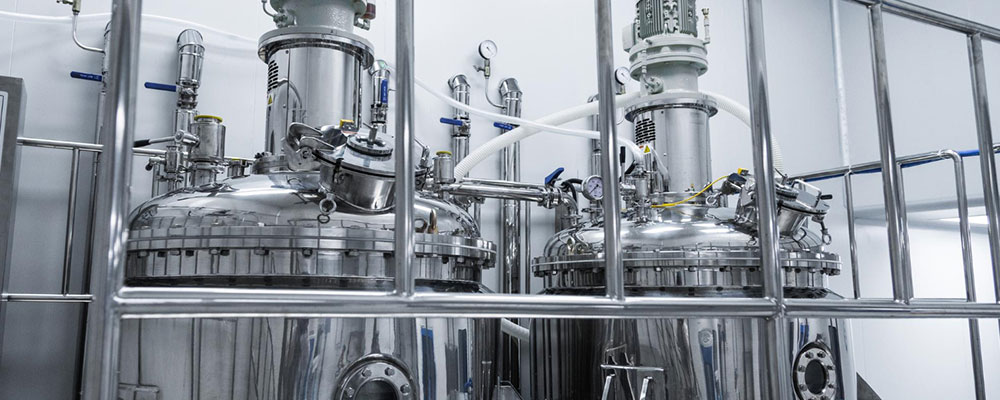
The technology used in grain distilleries is part of a much wider industrial enzyme ecosystem.
In sugar mills, alpha-amylase can be used to address starch-related processing challenges, while dextranase targets dextran and associated viscosity problems.
In tea processing, pectinase and related carbohydrases can modify plant cell-wall components and assist selected extraction and processing objectives.
In dairy processing, lactase hydrolyses lactose into simpler sugars, supporting lactose-reduced and lactose-free product development.
In the detergent industry, amylase targets starch-based soils, while proteases, lipases and cellulases provide complementary cleaning and fabric-care functions. Alpha-amylase has long been recognised as an industrial detergent enzyme.
In textile processing, alpha-amylase is used to remove starch-based sizing materials during desizing, while cellulases and other enzymes assist selected finishing applications.
In animal feed, protease can support protein hydrolysis, while phytase, xylanase and beta-glucanase target other nutritional constraints.
In water treatment, enzyme and biological approaches can help address specific organic components and support broader wastewater-treatment systems.
The common theme across all of these applications is not the industry itself, but the relationship between a specific enzyme, its target substrate and the process conditions under which it operates.
Energy Efficiency and the Evolution of Starch Hydrolysis
Enzyme technology is also being examined as part of broader efforts to reduce the energy intensity of starch conversion.
Conventional starch-to-ethanol production has traditionally involved substantial heating during gelatinisation and liquefaction, followed by saccharification and fermentation. Recent research into raw-starch-digesting glucoamylases is exploring whether some starch hydrolysis can occur at lower temperatures, potentially reducing energy requirements. However, the same research identifies limitations involving catalytic efficiency, enzyme dosage and stability under industrial fermentation conditions.
This illustrates the direction of current enzyme development: more activity at lower temperatures, improved stability, greater substrate accessibility and better integration with fermentation.
For distillery operators, such developments could create opportunities for future process redesign, although any change should be evaluated against the complete energy and economic balance of the plant.
Designing a Robust Enzyme Programme
A structured enzyme-development programme can be built around the following sequence:
- Characterise the raw material
Measure starch content, moisture and other relevant feedstock characteristics. - Define the process objective
Determine whether the priority is viscosity reduction, starch conversion, fermentable-sugar concentration, ethanol yield or a combination of these factors. - Select the enzyme system
Match alpha-amylase and glucoamylase characteristics to the process conditions. - Optimise operating conditions
Establish suitable temperature, pH, dosage, mixing and residence time. - Conduct controlled trials
Compare enzyme performance against a defined baseline. - Measure downstream effects
Assess fermentation and ethanol production, not only enzymatic conversion. - Evaluate economics
Consider enzyme cost alongside energy, water, throughput, yield and downstream benefits.
This process-based methodology is more dependable than selecting enzymes according to catalogue specifications alone.
Biolaxi Enzymes and Grain Distillery Applications
For commercial users, the relevance of an enzyme manufacturer extends beyond the supply of a catalyst. Distilleries require products that are compatible with their specific raw materials, operating conditions and production objectives.
Biolaxi Enzymes identifies grain-based distilleries as a specific application area and lists middle-temperature alpha-amylase, industrial glucoamylase and brewing-related enzymes within its range.
Its published enzyme information also describes high-temperature alpha-amylase for liquefaction and industrial glucoamylase for saccharification.
The broader Biolaxi portfolio includes amylases, glucoamylase, proteases, cellulases, xylanase, beta-glucanase, phytase, dextranase and other enzyme systems for sectors including alcohol, brewing, starch, detergents, textiles, animal feed and wastewater treatment.
For distillery decision makers, the practical value of such a portfolio is the ability to evaluate enzyme technology according to the actual process rather than viewing liquefaction and saccharification as isolated chemical steps.
Conclusion
Efficient grain distillery processing depends heavily on the conversion of starch into fermentable sugars. Gelatinisation makes starch accessible, alpha-amylase performs the crucial liquefaction step by breaking long starch molecules into shorter dextrins and reducing viscosity, and glucoamylase subsequently converts those dextrins into glucose for fermentation. Together, these enzymatic stages form the biochemical foundation of starch-to-ethanol production.
The effectiveness of the system depends on far more than enzyme dosage. Raw-material characteristics, temperature, pH, solids concentration, residence time, mixing and downstream fermentation conditions all influence the final result. High-solids processing presents additional challenges, making enzyme stability and substrate accessibility particularly important.
Biolaxi Enzymes addresses these processing requirements through enzyme solutions for grain-based distilleries, including alpha-amylase and industrial glucoamylase for liquefaction and saccharification. Its wider industrial portfolio also covers enzymes used in sugar processing, tea, dairy, detergents, textiles, feed and wastewater treatment, reflecting the broader application of substrate-specific enzymatic technology across manufacturing.
For modern distilleries, the strongest approach is to treat enzyme selection as a process-engineering decision. When the appropriate enzyme system is matched to the feedstock, operating conditions and production objective, liquefaction and saccharification can provide a more predictable route from grain starch to fermentable sugars, supporting efficient fermentation and better control of overall distillery performance.