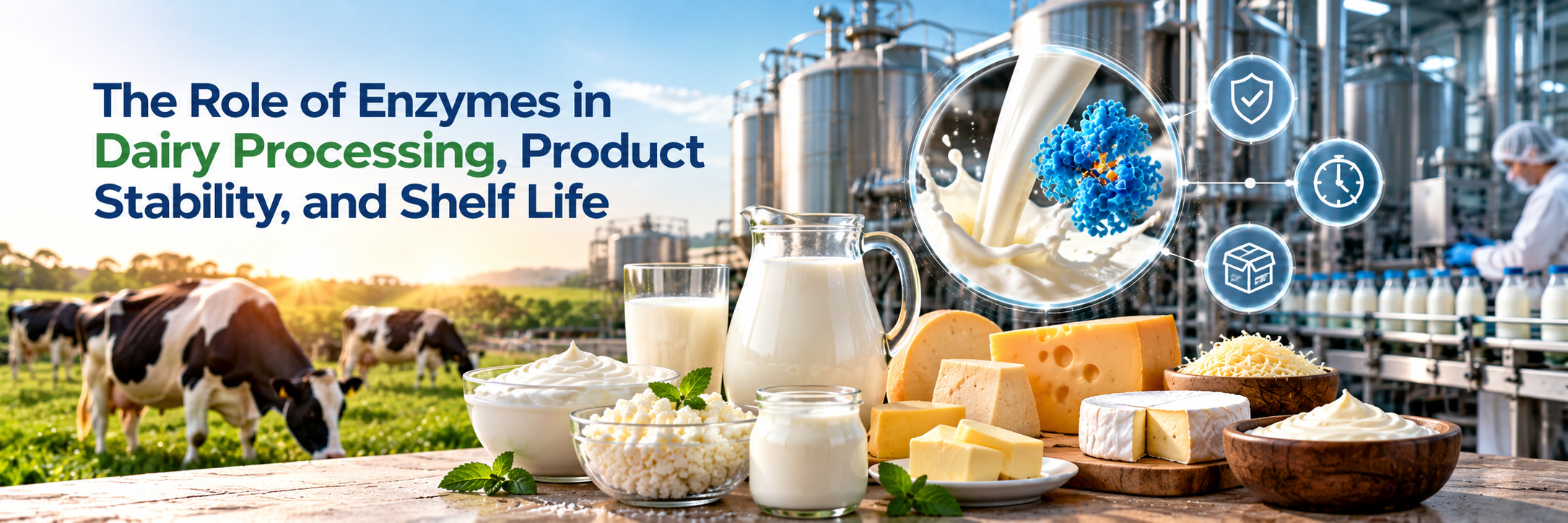
The dairy industry operates at the intersection of biological complexity, food safety and stringent quality expectations. Milk is a highly nutritious but chemically and microbiologically sensitive raw material, and converting it into products such as cheese, yoghurt, lactose-free milk, whey-based ingredients and other dairy formulations requires precise control of proteins, carbohydrates, fats and microorganisms. Enzymes play an important role in this environment because they can catalyse specific reactions with a high degree of selectivity. Commercial enzymes such as lactase, rennet or milk-clotting enzymes, proteases and lipases can influence lactose hydrolysis, coagulation, ripening, texture and flavour development. At the same time, unwanted enzymes produced by microorganisms can contribute to deterioration and reduced shelf life. Understanding both sides of enzyme activity is therefore essential for dairy manufacturers seeking consistent processing and stable finished products.
Why Enzyme Control Matters in Modern Dairy Manufacturing
Milk is not a static raw material. It contains proteins, lactose, minerals, lipids, enzymes and other components that continue to interact during processing and storage. Manufacturing processes such as pasteurisation, ultrafiltration, fermentation, coagulation and ripening deliberately change these components to create specific products.
Enzymes become important because many of these transformations involve controlled biochemical reactions.
For dairy processors, enzyme technology can contribute to several objectives:
- Converting specific milk components into more useful forms
- Improving processing efficiency
- Controlling coagulation and curd formation
- Modifying texture and flavour
- Supporting lactose-free and lactose-reduced product development
- Improving the consistency of specialised dairy products
- Supporting targeted protein or fat modification
However, the same biochemical activity can become undesirable when it is uncontrolled. Proteases and lipases originating from spoilage microorganisms, for example, can continue acting on milk components and contribute to bitterness, rancidity, gelation and other defects during storage. Recent research highlights the role of heat-resistant spoilage enzymes as an important factor in dairy stability.
This makes enzyme management a two-sided discipline: manufacturers need to encourage useful enzyme reactions while controlling undesirable ones.
Lactase and the Expansion of Lactose-Reduced Dairy Products

Lactose is the principal carbohydrate in milk. Some consumers have reduced ability to digest lactose because of insufficient lactase activity in the small intestine. From a processing perspective, this has created an important application for commercial beta-galactosidase, commonly known as lactase.
Lactase hydrolyses lactose into glucose and galactose:
Lactose → Glucose + Galactose
This conversion changes several characteristics of the product, including its lactose content and sweetness.
The commercial application of lactase has expanded beyond simply producing lactose-free milk. It can also be used in products where lactose reduction, improved solubility or specific formulation characteristics are desired. Scientific reviews identify lactase as one of the principal commercial enzymes used in dairy processing.
Biolaxi offers lactase enzyme powder for dairy applications and identifies its use in UHT processes as well as acid whey applications.
For manufacturers, the technical challenge is to achieve sufficient hydrolysis while maintaining flavour, texture, nutritional characteristics and process economics.
Processing Conditions Determine Lactase Performance
The activity of lactase is influenced by the environment in which the reaction occurs. Factors such as temperature, pH, enzyme dosage, lactose concentration and contact time can determine the extent of hydrolysis.
This is particularly relevant in industrial dairy manufacturing because different products operate under different process conditions.
For example, a process designed for refrigerated milk may present a different enzyme-treatment environment from one involving UHT processing or whey treatment.
Important considerations include:
1. Temperature
Enzyme activity changes with temperature. A higher temperature may accelerate a reaction up to a suitable operating range, but excessive heat can reduce enzyme stability.
2. pH
Different lactase preparations are designed to function at different pH conditions. The formulation therefore needs to match the product and treatment stage.
3. Contact Time
The available hydrolysis period determines the degree to which lactose can be converted. Longer processing time does not necessarily provide economic advantages if the desired level of hydrolysis can be achieved earlier.
4. Enzyme Dosage
Dosage must be established according to lactose concentration and processing objectives rather than treated as a fixed universal value.
5. Product Composition
Fat, protein, minerals and other components can influence the physical environment in which the enzyme operates.
For these reasons, enzyme selection should be integrated into the overall dairy process rather than treated as an isolated formulation decision.
Milk-Clotting Enzymes and the Architecture of Cheese
Cheese manufacture is one of the oldest and most important applications of industrial enzyme technology. Milk-clotting enzymes initiate the conversion of liquid milk into a structured curd.
Traditional rennet contains chymosin or related proteolytic activity capable of acting on casein, particularly kappa-casein. This destabilises the casein micelle system and allows the milk to coagulate under controlled conditions.
The coagulation step has consequences well beyond curd formation. The properties of the coagulum influence:
- Curd firmness
- Cutting behaviour
- Whey separation
- Moisture retention
- Cheese yield
- Texture
- Ripening behaviour
The choice of coagulant therefore becomes a significant product-development decision.
Recent scientific reviews note increasing interest in microbial milk-clotting enzymes as alternatives or complements to conventional animal rennet. The ratio between milk-clotting activity and general proteolytic activity is particularly important: excessive non-specific proteolysis can negatively affect cheese quality, while inadequate coagulation can produce weak curd structure and lower yield.
This demonstrates why enzyme specificity matters in dairy processing.
Proteases, Ripening and Controlled Protein Modification
After coagulation, cheese undergoes a complex ripening process involving continuing biochemical changes. Proteolysis is one of the major mechanisms contributing to texture and flavour development.
Proteases break down milk proteins into progressively smaller peptides and amino acids. In a controlled ripening process, this contributes to the development of the desired structure and sensory profile.
Commercial proteases can therefore be used in selected applications to influence:
- Cheese maturation
- Texture development
- Flavour generation
- Protein hydrolysis
- Whey-protein and dairy-ingredient processing
However, excessive proteolysis can produce undesirable bitterness or structural weakness. The objective is therefore controlled modification rather than maximum enzyme activity.
Scientific literature identifies proteases as one of the principal commercial enzyme classes used in dairy processing, particularly for cheese manufacture and protein modification.
Lipases and the Development of Dairy Flavour
Lipases act on fats and release fatty acids from triglycerides. In dairy processing, this activity has particular relevance to cheese ripening and flavour formation.
The release of specific fatty acids can contribute to the characteristic flavour and aroma profiles of certain cheeses. However, the degree of lipolysis must be controlled because excessive fat hydrolysis can generate unwanted rancid notes.
Commercial lipases can therefore be selected according to:
- Desired flavour intensity
- Cheese variety
- Ripening period
- Fat composition
- Processing temperature
- Target sensory profile
Research reviews describe lipases as important commercial dairy enzymes because of their role in cheese flavour, body and texture development.
The commercial lesson is similar to that for proteases: enzyme specificity and controlled activity are more valuable than indiscriminate enzymatic action.
Product Stability Begins with Controlling Unwanted Enzymatic Activity
Enzymes are not always beneficial in dairy systems.
Milk can become contaminated with microorganisms capable of producing extracellular proteases and lipases. Some of these enzymes may remain active even after thermal processing if they possess sufficient heat stability.
This creates an important distinction between destroying microorganisms and controlling the enzymes they have already produced.
Recent research identifies microbial proteases and lipases as significant contributors to dairy spoilage. Their activity can lead to:
- Protein breakdown
- Bitterness
- Rancid flavours
- Gelation in stored milk
- Changes in texture
- Reduced product acceptability
Heat-resistant enzymes are particularly challenging because standard thermal treatments may reduce the microbial population without completely eliminating previously formed enzyme activity.
For manufacturers of extended-shelf-life and UHT products, this makes raw-material quality, hygienic design, microbial control and cold-chain management essential components of enzyme management.
Raw Milk Quality Has a Direct Influence on Shelf Life
The shelf life of a dairy product does not begin at the packaging stage. It is influenced by the quality of the raw milk entering the processing plant.
Microbial contamination before processing can allow spoilage organisms to multiply and produce enzymes. Even when subsequent thermal treatment significantly reduces the viable microbial population, extracellular enzymes may remain sufficiently active to affect product quality during storage.
This makes several upstream controls important:
- Effective farm-level hygiene
- Rapid cooling after milking
- Temperature-controlled transportation
- Appropriate milk storage conditions
- Microbiological testing
- Timely processing
- Cleaning and sanitation of processing systems
Enzyme-related spoilage is therefore partly a raw-material management issue.
How Enzymes Influence Dairy Product Texture and Functionality
Modern dairy products increasingly rely on controlled texture and functional behaviour.
Consumers may expect yoghurt to have a stable structure, cheese to exhibit a particular firmness and elasticity, and lactose-free milk to retain a sensory profile comparable to conventional milk.
Enzymes can influence these properties through targeted biochemical modification.
For example, proteolysis changes the protein network in cheese. Lactase changes lactose composition and sweetness. Milk-clotting enzymes influence curd formation and subsequent moisture retention. Lipases alter fat breakdown and flavour development.
This means that enzyme selection should begin with the desired product characteristic.
A useful development framework is:
Desired product property → target substrate → suitable enzyme → controlled process conditions → validated product outcome
This approach is more reliable than selecting an enzyme solely on the basis of its activity specification.
Whey and Dairy By-Product Processing
The growth of value-added dairy production has increased attention on the efficient utilisation of whey and other dairy streams.
Whey contains significant quantities of lactose and soluble proteins. Enzyme technology can assist in converting these components into products with specific nutritional or functional characteristics.
Lactase is particularly relevant where lactose hydrolysis is desired. Enzymatic hydrolysis can produce glucose and galactose and can also support further processing opportunities.
The wider significance is that dairy enzymes are not limited to traditional products such as cheese and milk. They can also support the development of functional ingredients, specialised formulations and higher-value processing streams.
This fits within a broader industrial movement towards extracting greater value from existing raw materials rather than treating secondary streams only as waste.
Enzyme Compatibility with Industrial Processing
A commercially useful enzyme must be compatible with the realities of a dairy plant.
Industrial operations can involve:
- Pasteurisation
- UHT processing
- Homogenisation
- Fermentation
- Refrigerated storage
- Membrane filtration
- CIP systems
- Continuous processing
An enzyme intended for use in one stage may not be suitable for another.
Stability is therefore a major selection criterion. Manufacturers need to know whether an enzyme will remain active for the required period, whether it can tolerate the intended process conditions and when its activity needs to be stopped.
Process engineers and formulation teams should assess enzyme behaviour under realistic conditions rather than relying exclusively on standard laboratory assays.
Enzymes Beyond Dairy: A Connected Industrial Processing Ecosystem
The principles of enzyme technology in dairy are closely related to applications in other industries.
In tea processing, pectinase, cellulase and related carbohydrases can modify plant cell-wall structures and support extraction and processing objectives.
In the detergent industry, proteases hydrolyse protein-based soils, while lipases, amylases and cellulases target other classes of contaminants and support cleaning performance.
In textile processing, alpha-amylase is used for desizing because it selectively hydrolyses starch-based sizing materials. Other enzyme systems can support bioscouring and finishing processes.
In animal feed, proteases can increase the accessibility of dietary protein, while phytase, xylanase and beta-glucanase address phytate and non-starch polysaccharide-related limitations.
In water treatment, enzyme and microbial systems can assist the degradation of selected organic materials and contribute to integrated wastewater-treatment strategies.
In sugar mills, amylase and dextranase can target starch and dextran-related processing challenges.
In grain distilleries, alpha-amylase and glucoamylase are used during starch liquefaction and saccharification to convert starch into fermentable sugars.
Biolaxi’s published portfolio reflects this cross-industry application of enzyme technology, with products covering amylases, proteases, cellulases, xylanase, beta-glucanase, glucoamylase, phytase, dextranase and specialised enzyme formulations across industrial sectors.
The common principle is not the industry itself, but the substrate being targeted and the process outcome required.
Optimising Shelf Life Through Process, Not Enzymes Alone

It is important to distinguish between enzymes deliberately added to a food product and enzymes that arise unintentionally from microbial contamination.
Added enzymes are selected for a desired transformation and are usually applied under controlled conditions.
Unwanted enzymes require a different strategy. The emphasis is on prevention, monitoring and process control.
A dairy producer seeking improved shelf life should therefore evaluate the complete production chain:
- Raw milk quality
- Microbiological load
- Cooling and storage
- Thermal processing
- Enzyme stability
- Packaging integrity
- Storage temperature
- Distribution conditions
This is particularly relevant to products with long intended shelf lives, where even relatively slow enzymatic reactions can become commercially significant over time.
Recent research on dairy spoilage enzymes reinforces the need for precise monitoring because enzymatic deterioration can continue even when microbial counts appear adequately controlled.
Application Trials Are Essential for Commercial Scale-Up
The same enzyme can behave differently depending on the product matrix and manufacturing environment.
A laboratory trial should therefore be treated as the beginning of process development rather than the final proof of performance.
A structured dairy enzyme evaluation can involve:
- Establishing the existing process baseline
- Defining the desired product characteristics
- Identifying the target substrate
- Selecting an appropriate enzyme
- Optimising dosage
- Evaluating temperature and pH
- Assessing contact time
- Monitoring product quality
- Conducting sensory evaluation
- Testing storage stability
- Validating production-scale consistency
This approach allows the manufacturer to quantify the actual contribution of the enzyme.
For enterprise decision makers, such validation is also important from a cost perspective. An enzyme programme should be judged according to improvements in yield, quality, processing efficiency, product functionality or shelf-life performance rather than on enzyme price alone.
The Role of Technical Expertise in Enzyme Selection
Industrial enzyme procurement should not be reduced to selecting the highest activity specification or lowest cost per kilogram.
The appropriate enzyme partner should be able to address questions such as:
- What is the target substrate?
- At what processing stage should the enzyme be introduced?
- What operating conditions maximise useful activity?
- How stable is the enzyme during storage and processing?
- What dosage range is appropriate?
- How should performance be measured?
- How will the enzyme interact with the existing process?
Biolaxi Enzymes lists lactase as part of its dairy enzyme range and identifies applications including UHT processing and acid whey. Its wider enzyme portfolio covers multiple industrial applications, enabling a broader approach to substrate-specific process challenges.
For dairy manufacturers, this type of application-oriented approach is particularly relevant because the desired result often depends as much on process integration as on enzyme selection.
Future Directions in Dairy Enzyme Technology
Dairy enzyme technology continues to evolve alongside changes in consumer requirements, manufacturing practices and sustainability priorities.
Several areas are likely to remain important:
1. More Specific Enzyme Systems
Greater substrate specificity can help manufacturers achieve a defined outcome while minimising unintended changes to the product.
2. Alternative Milk-Clotting Enzymes
Research into microbial milk-clotting enzymes is expanding, particularly as manufacturers evaluate alternatives to conventional animal rennet.
3. Specialised Lactose Management
Lactase technology is likely to remain relevant as the market for lactose-reduced and lactose-free dairy products develops.
4. Functional Dairy Ingredients
Controlled protein hydrolysis and related enzyme technologies may contribute to the development of whey-derived ingredients, hydrolysates and specialised nutrition products.
5. Better Spoilage Control
Understanding and monitoring heat-resistant spoilage enzymes will remain important for manufacturers focused on extended shelf life and product stability.
These developments point towards a more precise form of dairy biotechnology in which enzymes are selected according to defined product and process requirements.
Conclusion
Enzymes have a dual role in dairy manufacturing. Deliberately selected enzymes can enable highly controlled transformations, while uncontrolled enzymatic activity can contribute to product deterioration. Lactase can hydrolyse lactose for specialised milk products, milk-clotting enzymes can initiate cheese coagulation, proteases can influence protein transformation and ripening, and lipases can contribute to the development of characteristic dairy flavours. Commercial dairy enzyme applications are therefore closely connected with product functionality, processing efficiency and quality consistency.
At the same time, unwanted microbial proteases and lipases can reduce stability and shelf life, particularly when heat-resistant enzymes remain active after thermal treatment. Effective dairy manufacturing therefore requires a balanced approach that combines enzyme selection with raw-material control, hygiene, thermal processing, storage management and analytical monitoring.
Biolaxi Enzymes addresses these requirements through its dairy enzyme offering, including lactase for applications such as UHT processing and acid whey, supported by a wider portfolio of industrial enzyme technologies. Its relevance extends beyond dairy, with enzyme solutions across tea processing, detergents, textiles, feed, water treatment, sugar processing and grain-based applications.
For dairy manufacturers, the strategic value of enzymes lies in precision and process control. The most effective programmes begin by identifying the desired product characteristic or processing challenge, selecting an enzyme with the appropriate activity, establishing suitable operating conditions and validating the result at commercial scale. As dairy manufacturing continues to pursue greater product differentiation, resource efficiency and consistency, enzyme technology will remain an important tool for improving both processing performance and finished-product quality.