
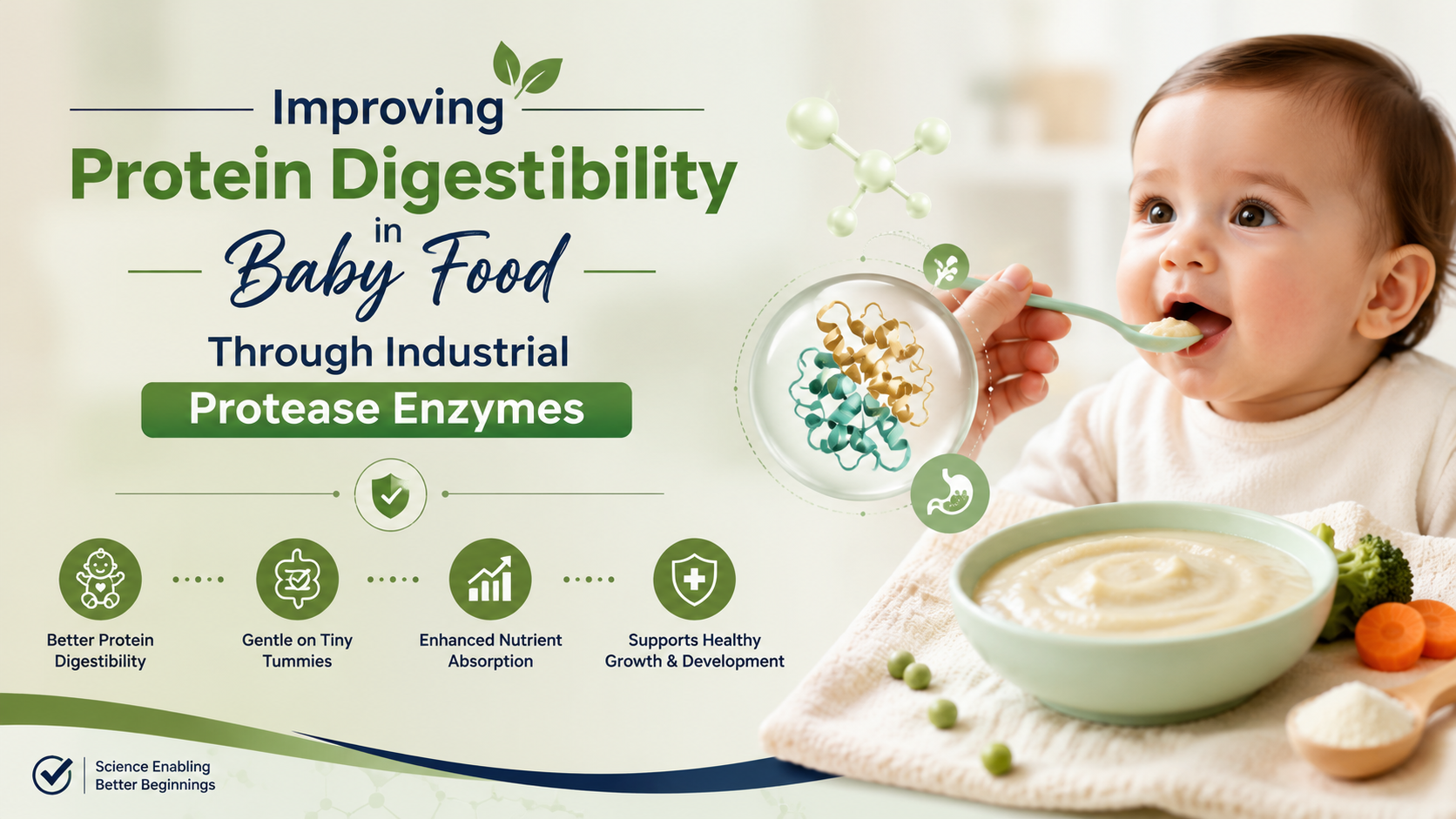
Infant nutrition demands far greater precision than conventional food production. During the first years of life, babies require foods that not only provide essential nutrients but also support an immature digestive system that is still developing its natural enzyme activity. Protein is one of the most important nutrients for growth, yet it is also among the most challenging for infants to digest efficiently.
Modern food manufacturers are increasingly addressing this challenge through enzyme technology. By using industrial protease enzymes during production, proteins can be partially hydrolysed before the food reaches the consumer. This creates baby food that is easier to digest, supports nutrient absorption, and delivers consistent quality without compromising nutritional value.
Why Protein Digestibility Matters in Infant Nutrition
Proteins supply the amino acids required for muscle development, tissue repair, immune function, and healthy growth. However, infants naturally produce lower levels of digestive proteases than older children and adults. Their digestive systems are still maturing, making it more difficult to break down large protein molecules efficiently.
When proteins remain only partially digested, babies may experience digestive discomfort, slower nutrient absorption, or difficulty tolerating certain protein sources. This is particularly important when introducing complementary foods or specialised infant formulations.
Improving protein digestibility helps ensure that nutrients become more readily available while placing less strain on the developing digestive system.
How Industrial Protease Enzymes Work
Protease enzymes are specialised biological catalysts that break peptide bonds within proteins. During food processing, they convert large protein molecules into smaller peptides and free amino acids that are significantly easier to digest.
Rather than changing the nutritional importance of protein, this controlled hydrolysis simply makes it more accessible to the infant digestive system.
The process closely resembles natural digestion and offers manufacturers greater control over the final characteristics of the product. Once processing is complete, the enzymes are inactivated, ensuring they do not continue reacting after production.
Benefits for Baby Food Manufacturers

Industrial protease technology offers several advantages throughout baby food production.
- Improves protein digestibility for developing digestive systems
- Increases amino acid availability for improved nutrient absorption
- Produces smoother textures suitable for infant foods
- Supports consistent product quality across production batches
- Allows controlled protein hydrolysis based on formulation requirements
These benefits help manufacturers develop products that meet both nutritional expectations and modern quality standards.
Supporting Better Nutrient Absorption
Digestibility and nutrient absorption are closely connected. Even protein-rich foods provide limited benefit if proteins cannot be efficiently broken down into absorbable amino acids.
Protease treatment helps overcome this limitation. Smaller peptides require less digestive effort and are absorbed more readily by the body. As a result, infants gain improved access to the building blocks needed for healthy growth, cognitive development, and immune function.
This enhanced bioavailability becomes particularly valuable in specialised nutritional products designed for sensitive infants or those with increased nutritional requirements.
Improving Texture and Product Quality
Texture plays an important role in infant feeding. Baby foods must remain smooth, uniform, and easy to swallow while maintaining nutritional integrity.
Controlled protein hydrolysis contributes to improved product consistency by reducing the presence of larger protein aggregates. The result is a smoother mouthfeel and better overall product stability during processing.
Manufacturers also benefit from greater formulation flexibility, allowing them to create products suitable for different stages of infant development.
Supporting Sensitive Digestive Systems
Some protein sources, particularly dairy and plant proteins, can be difficult for young digestive systems to process completely. Carefully controlled enzymatic hydrolysis reduces protein complexity without compromising nutritional value.
This gentle modification helps create products that are generally easier to tolerate while maintaining the essential amino acids required for healthy development.
For manufacturers producing specialised infant nutrition, enzyme technology provides a reliable approach to improving digestibility while maintaining strict quality standards.
A More Precise Alternative to Traditional Processing
Traditional processing methods such as high heat or mechanical treatment can improve texture but have limited ability to enhance protein digestibility. Excessive thermal processing may also affect sensitive nutrients and alter product characteristics.
Enzyme-assisted processing offers a more targeted solution. Because proteases work under controlled processing conditions, manufacturers can achieve the desired level of protein hydrolysis with greater precision and consistency.
This allows production teams to optimise digestibility while preserving nutritional quality, flavour, and product performance.
Advancing Modern Infant Nutrition

The baby food industry continues to evolve as parents seek products supported by nutritional science, clean processing methods, and reliable quality. Enzyme technology has become an important part of this progress by helping manufacturers create foods that better match the digestive capabilities of infants.
Ongoing research is expanding the development of advanced protease formulations with improved specificity, allowing producers to optimise protein functionality for different infant nutrition applications while maintaining high standards of safety and consistency.
Conclusion
Protein remains one of the most important nutrients during early childhood, but its nutritional value depends greatly on how efficiently it can be digested and absorbed. Industrial protease enzymes help improve protein digestibility by converting complex proteins into smaller, more accessible peptides before consumption. This supports better nutrient availability, smoother product texture, and more consistent manufacturing outcomes while addressing the unique digestive needs of infants.
At Biolaxi Enzymes Pvt. Ltd., we develop advanced protease enzyme solutions that help food manufacturers produce high-quality infant nutrition products with improved digestibility and consistent performance. Through scientific innovation and customised enzyme technology, we support the development of baby foods that combine nutritional excellence with efficient, reliable processing.