
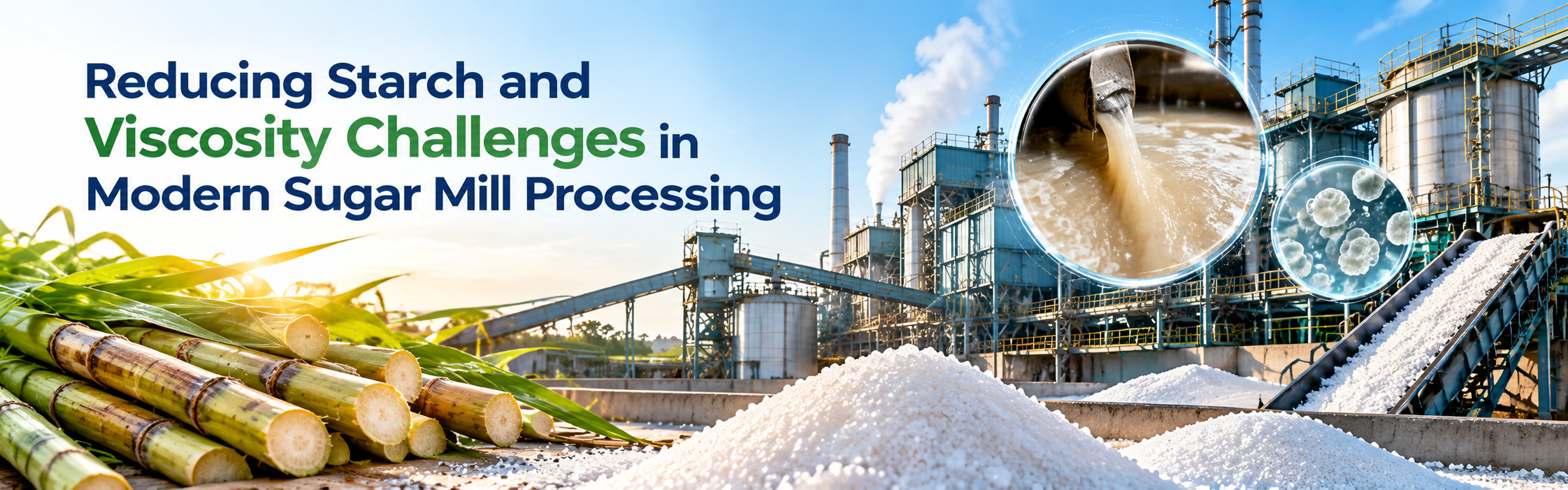
Sugar manufacturing is a highly integrated process in which the quality of incoming cane, the condition of the juice and the efficiency of each processing stage can directly influence overall sugar recovery and product quality. Among the less visible but operationally significant challenges are starch and dextran accumulation, both of which can alter the physical behaviour of process streams. Excessive viscosity can interfere with clarification, evaporation, crystallisation and centrifugation, while starch can affect downstream processing and contribute to filtration and clarification difficulties. Enzyme technology provides a targeted approach to these problems by breaking down specific polymers under controlled process conditions. In particular, amylases and dextranases can help mills manage starch and dextran-related challenges as part of a broader process-optimisation strategy.
Why Polymer Build-Up Matters in Sugar Processing
Modern sugar mills operate with tightly connected process stages, from juice extraction and clarification through evaporation, crystallisation and centrifugal separation. A disturbance introduced early in the process can therefore have consequences much further downstream.
Starch and dextran are two examples of compounds that can create such disruption.
Starch is naturally present in sugarcane and can become more relevant when immature, damaged or deteriorated cane enters the factory. Although starch itself is not the same problem as dextran, both represent polymeric materials that can affect process behaviour when present at elevated levels.
Dextran is particularly important because it can be generated when microorganisms such as Leuconostoc and certain Lactobacillus species act on sucrose in deteriorated or delayed-processing cane. High-molecular-weight dextran can increase the viscosity of juice and syrup and interfere with clarification, filtration, evaporation and sucrose crystallisation. Research has associated dextran contamination with sucrose losses, reduced recovery and changes in crystal characteristics.
Understanding the Starch Problem
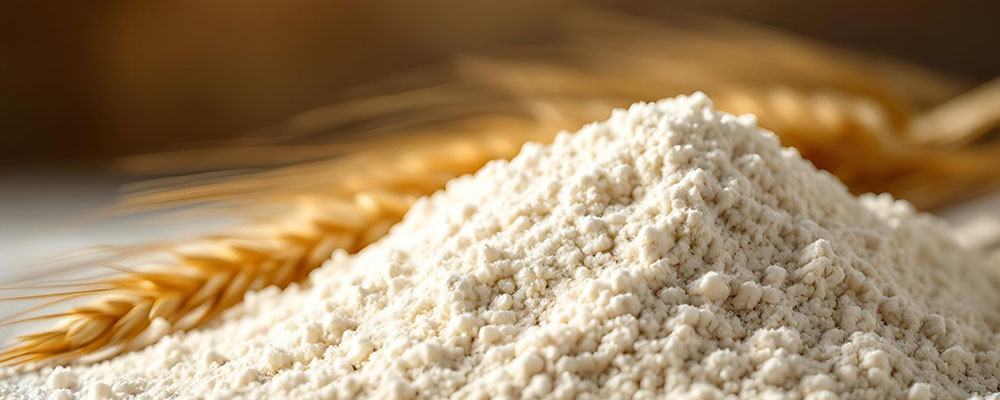
Starch is a polysaccharide made up primarily of glucose units linked into long molecular chains. In sugarcane processing, starch can enter the factory with the cane and subsequently become associated with juice and syrup streams.
As processing conditions change, the physical behaviour of starch can become important. Larger starch molecules can contribute to increased viscosity and may interfere with the movement and separation of process streams. In addition, starch can complicate clarification and filtration, particularly where its concentration and interaction with other non-sugar solids become significant.
This is where amylase-based treatment can provide a targeted solution.
Alpha-amylase hydrolyses internal alpha-1,4 glycosidic linkages within starch molecules. Rather than leaving the starch as a long-chain polymer, the reaction produces shorter dextrins and oligosaccharides. The reduction in molecular size can contribute to lower viscosity and improved handling of starch-containing streams.
The principle is particularly valuable where high temperatures are part of the industrial process. High-temperature alpha-amylase products are designed to retain activity under demanding thermal conditions, allowing starch hydrolysis to take place where conventional enzymes might lose effectiveness.
Why Viscosity Is More Than a Measurement
Viscosity is often treated as a process parameter, but in a sugar factory it can be an indicator of how easily materials move through the system and how efficiently mass transfer and separation can occur.
Elevated viscosity can affect:
- Flow through pipes, channels and process equipment
- Filtration rates
- Evaporation behaviour
- Heat and mass transfer
- Crystallisation rates
- Centrifugal separation
- Washing and separation of sugar crystals
Dextran: A Different Polymer with a Different Enzymatic Solution
Although starch and dextran can both contribute to processing difficulties, they require different enzymatic approaches because their molecular structures are different.
Dextran is an alpha-glucan consisting predominantly of glucose units linked through alpha-1,6 bonds, with branching patterns that can vary. Its high molecular weight is an important reason for its effect on viscosity.
Dextranase is specifically designed to hydrolyse dextran. By cleaving the relevant glycosidic linkages, the enzyme reduces the molecular size of dextran and can consequently reduce its contribution to viscosity.
This selectivity is one of the central advantages of enzyme-based process intervention. Rather than attempting to alter the entire composition of a juice stream, the objective is to target a specific polymer responsible for a defined process problem.
Scientific literature identifies dextranase as a long-established enzymatic approach in sugar manufacturing. It has been used to address dextran-contaminated process streams and support the recovery of normal processing conditions.
Where Enzyme Intervention Fits into the Mill Process
Enzyme treatment is most effective when its position in the process is selected according to the target substrate and the operating environment.
For dextran, published factory studies have examined application in juice streams before clarification, where sufficient residence time and appropriate temperature can allow the enzyme to act before the material proceeds further through the factory. The effectiveness of treatment depends on factors including pH, temperature, residence time, substrate concentration, enzyme dosage and the initial dextran load.
For starch, the appropriate treatment point depends on the type of amylase selected and the temperature and pH conditions of the process stream. High-temperature alpha-amylases are particularly relevant where starch needs to be hydrolysed under elevated-temperature conditions.
The practical lesson is that enzyme selection and dosing cannot be separated from process engineering.
A technically appropriate enzyme applied at an unsuitable point may perform poorly, while the same enzyme used under suitable conditions may deliver a substantially more useful result.
Managing Starch Through Amylase Technology
Amylase-based treatment can be considered when starch is creating measurable processing difficulties.
The basic mechanism is straightforward:
Starch → enzymatic hydrolysis → shorter-chain dextrins and oligosaccharides → reduced polymeric complexity and potentially lower viscosity
The actual outcome depends on the starch concentration, enzyme activity, temperature, pH, contact time and mixing conditions.
Commercial enzyme systems may be designed to provide:
- Effective starch hydrolysis under process conditions
- Activity across suitable temperature ranges
- Reduced viscosity associated with starch polymers
- Greater process flexibility
- Compatibility with continuous processing
Dextranase as a Tool for Restoring Processability
Dextran-related problems can be particularly difficult because the polymer may remain influential even when its concentration is not exceptionally high. High-molecular-weight dextran can have a disproportionate effect on viscosity and process behaviour.
The objective of dextranase treatment is not necessarily to remove every molecule of dextran. Instead, hydrolysis lowers the molecular size of the polymer and can reduce its impact on the rheological properties of the process stream.
This can support improved:
- Juice filtration
- Syrup handling
- Evaporation
- Massecuite movement
- Crystallisation
- Centrifugal separation
The Link Between Raw Cane Quality and Enzyme Demand
Enzyme treatment should not be viewed independently from cane handling.
Post-harvest deterioration is one of the factors associated with increased dextran formation. Delays between cutting and crushing, microbial activity and adverse storage or handling conditions can increase deterioration and contribute to processing complications. Literature on sugarcane post-harvest quality links deterioration with dextran formation, increased viscosity and lower sugar recovery.
This has an important management implication.
Enzymes can help address the consequences of polymer accumulation, but they do not replace good agricultural, harvesting, transport and mill-hygiene practices. A comprehensive strategy combines preventive measures with process intervention.
For mills, this means considering the entire chain:
Cane quality → harvesting and transport → time to crushing → microbial activity → polymer formation → enzymatic intervention → process performance
Moving Towards More Targeted Process Control
Traditional sugar-processing operations rely extensively on temperature, pH adjustment, clarification chemicals, heating, filtration and mechanical separation. These remain fundamental technologies.
Enzymes add another dimension by introducing biochemical specificity.
Instead of increasing treatment intensity across the entire process, an enzyme can be selected to act primarily on the compound responsible for a particular problem.
This can be especially valuable in situations where:
- A specific polymer is responsible for increased viscosity.
- Conventional treatment cannot sufficiently address the compound.
- Increased chemical treatment could affect other process characteristics.
- The mill needs to improve an existing process without major equipment changes.
- Variability in incoming cane makes polymer loads difficult to predict.
What Other Industries Can Learn from the Sugar Sector
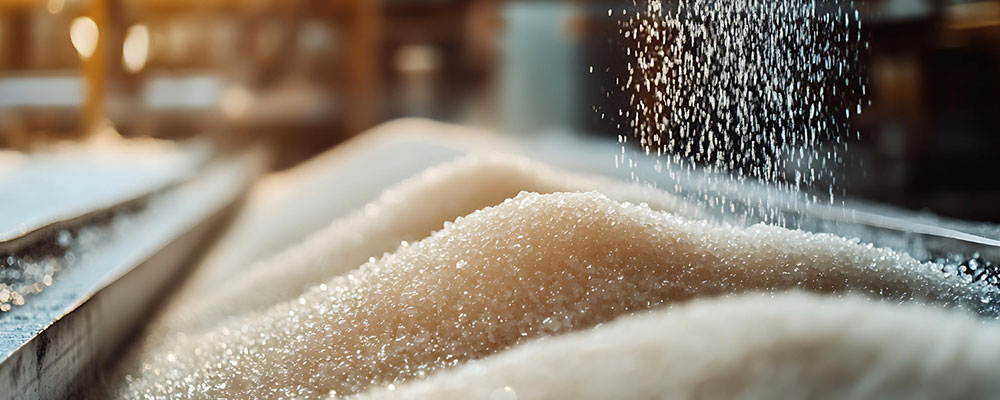
The same principles behind starch and viscosity management in sugar mills appear across other industrial applications.
In the detergent industry, amylases, proteases, lipases and cellulases are selected according to the chemical nature of soils and the desired cleaning performance.
In textile processing, enzymes such as amylases are used for desizing, while cellulases can assist selected fabric-finishing processes.
In feed manufacturing, amylase can act on starch, helping to reduce viscosity and improve the accessibility of nutrients.
In tea processing, pectinase can be used to act on plant-derived structural components and assist specific extraction or clarification objectives.
In dairy processing, enzymes such as lactase can modify lactose and support the manufacture of specialised dairy products.
In wastewater treatment, enzyme systems can assist the degradation of specific organic substrates and form part of integrated approaches to sludge and effluent management.
Across these applications, the principle remains consistent: identify the material creating the processing bottleneck, determine its biochemical structure and select an enzyme capable of acting on it under practical operating conditions.
Enzyme Selection Should Reflect the Process Environment
Every sugar mill operates under a particular combination of raw-material quality, temperature profile, pH, residence time, equipment configuration and production targets.
Consequently, there is no universal dosage or application point that can be assumed to work across all factories.
Important selection criteria include:
- Thermal stability
- pH compatibility
- Substrate specificity
- Residence time
- Enzyme activity
- Process consistency
Building a Practical Enzyme Programme for a Sugar Mill
An enzyme programme should be established through a structured technical evaluation rather than introduced solely as a chemical-addition exercise.
A practical assessment can include:
- Establishing a baseline for viscosity, starch, dextran and relevant process indicators.
- Identifying the likely source and severity of the polymer-related problem.
- Selecting the appropriate enzyme activity.
- Evaluating pH, temperature and contact-time requirements.
- Conducting laboratory or controlled plant trials.
- Optimising dosage and application point.
- Monitoring downstream effects on filtration, evaporation and crystallisation.
- Evaluating recovery, quality and overall economics.
- Establishing a repeatable operating protocol.
The Broader Business Case for Enzymatic Process Optimisation
For sugar manufacturers, enzyme adoption should ultimately be evaluated in terms of plant performance.
The potential business impact may include more stable processing, improved handling of difficult juice and syrup streams, better crystallisation behaviour and reduced losses associated with polymer-related disruption.
The broader value proposition can therefore be framed around four objectives:
- Process stability: reducing the impact of variable starch and dextran loads.
- Operational efficiency: supporting smoother filtration, evaporation and crystallisation.
- Product quality: helping minimise polymer-related effects on sugar crystals and downstream products.
- Resource utilisation: improving the ability of existing equipment to operate within its intended process range.
Conclusion
Starch and dextran illustrate how relatively small changes in the biochemical composition of sugarcane process streams can have significant consequences for a modern sugar mill. Starch can contribute to processing difficulties when present at problematic concentrations, while dextran is particularly important because its high molecular weight can increase viscosity and interfere with filtration, evaporation, crystallisation and separation.
Enzyme technology provides a more targeted way to address these challenges. Amylases can hydrolyse starch into smaller molecules, while dextranases selectively break down dextran and reduce its molecular size and associated viscosity effects. The effectiveness of both approaches depends on choosing appropriate enzymes and integrating them into the right process conditions.
The wider lesson extends beyond sugar manufacturing. Whether the challenge involves starch in sugar processing, proteins in detergents and feed, plant polymers in tea processing, fibres in textiles or organic matter in wastewater, successful enzyme application begins with understanding the substrate and the process environment.
Biolaxi Enzymes brings this application-oriented approach to industrial enzyme development, with products spanning amylases, dextranase and other enzyme systems used across sugar and bioethanol, food, detergent, textile, feed and wastewater-related applications. Its published portfolio reflects a focus on matching enzyme functionality to specific industrial processing requirements.
For sugar mills seeking greater control over polymer-related processing challenges, the role of enzymes is therefore best understood not as a standalone corrective measure, but as part of a broader strategy for process optimisation, recovery improvement and more consistent manufacturing performance.