
Black tea remains one of the world’s most widely consumed beverages, with global demand continuing to grow across retail, hospitality and foodservice markets. Consumers increasingly expect tea that delivers consistent flavour, rich colour, distinctive aroma and premium quality regardless of seasonal variations in raw materials. For tea manufacturers, meeting these expectations requires precise control over every stage of production while maintaining operational efficiency and sustainability.
One of the key factors influencing black tea quality is the series of enzymatic reactions that occur during processing. While tea leaves naturally contain enzymes that drive oxidation, advances in industrial enzyme technology have enabled manufacturers to better understand, optimise and support these biochemical transformations. Controlled enzyme-assisted processing helps improve consistency, maximise the utilisation of raw materials and enhance the sensory characteristics of finished tea.
The significance of enzyme technology extends well beyond tea manufacturing. Similar biological solutions are widely used across commercial baking, dairy processing, detergent formulation, textile finishing, animal nutrition, wastewater treatment and sugar manufacturing, where they improve productivity, product quality and process sustainability.
Understanding the Composition of Fresh Tea Leaves
Fresh tea leaves contain a complex mixture of naturally occurring compounds that determine the final quality of black tea.
Key components include:
- Polyphenols
- Catechins
- Amino acids
- Proteins
- Carbohydrates
- Caffeine
- Essential oils
- Natural enzymes
The interaction between these compounds during processing determines the tea’s:
- Colour
- Aroma
- Flavour
- Mouthfeel
- Brightness
- Overall quality
Among these constituents, naturally occurring enzymes play a particularly important role in transforming freshly harvested green leaves into finished black tea.
The Role of Enzymes in Black Tea Manufacturing
Enzymes act as biological catalysts that accelerate highly specific biochemical reactions.
During tea processing, naturally occurring enzymes initiate controlled oxidation reactions that convert simple polyphenolic compounds into the complex pigments and flavour molecules characteristic of black tea.
These reactions contribute to:
- Rich amber liquor
- Balanced flavour
- Pleasant aroma
- Reduced bitterness
- Improved colour development
Carefully managing enzymatic activity is therefore one of the most critical aspects of premium tea production.
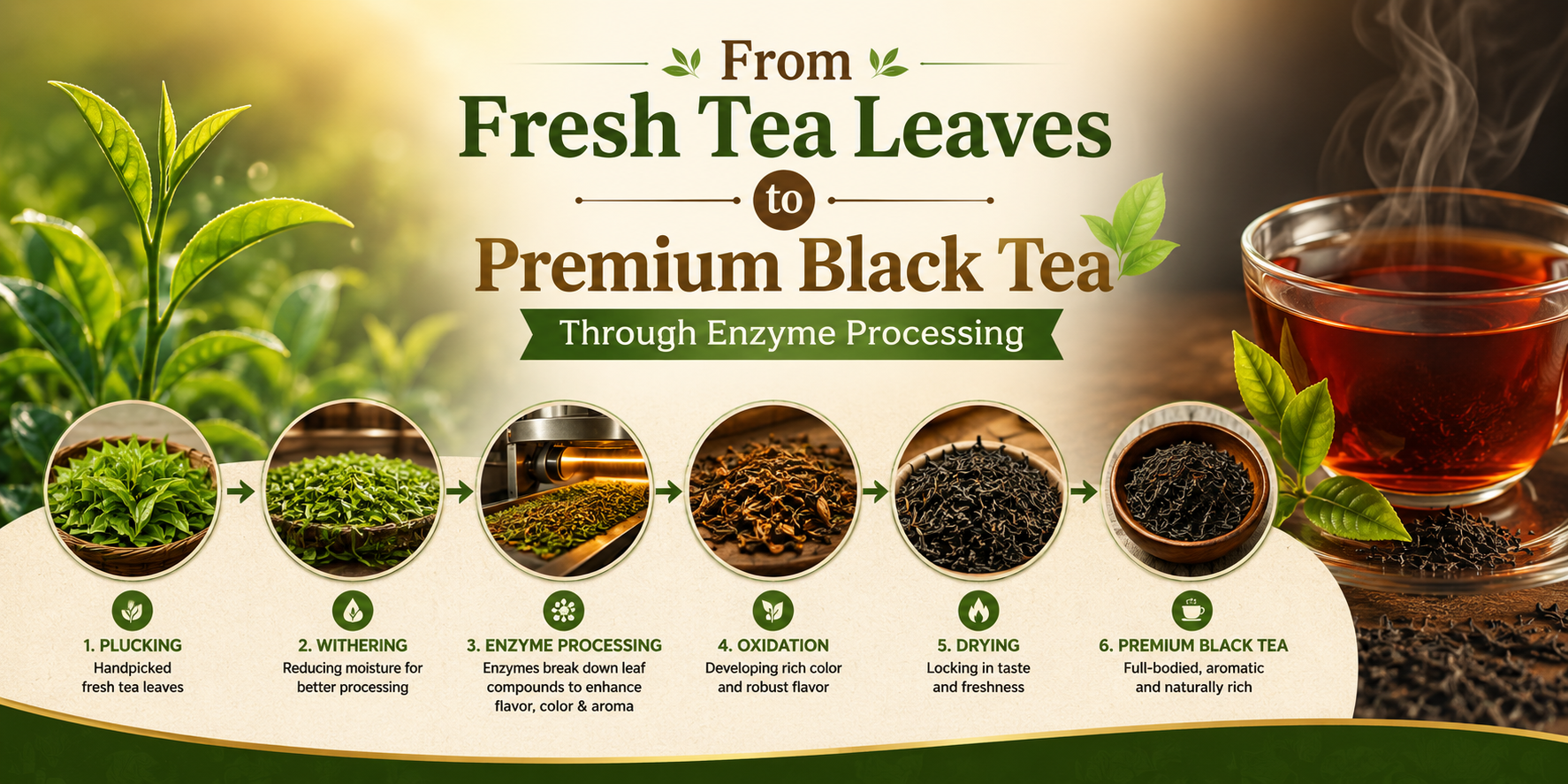
The Journey from Fresh Leaves to Black Tea
Producing high-quality black tea involves a series of carefully controlled processing stages.
Each stage influences enzyme activity and ultimately determines product quality.
1. Harvesting
Tea quality begins with proper harvesting.
Manufacturers typically select:
- Young shoots
- Tender leaves
- Fresh buds
High-quality raw material provides the foundation for successful enzymatic processing.
2. Withering
Freshly harvested leaves contain significant moisture.
During withering:
- Moisture content decreases.
- Leaves become more pliable.
- Cellular structures begin to change.
- Enzyme accessibility improves.
This stage prepares leaves for the biochemical reactions that follow.
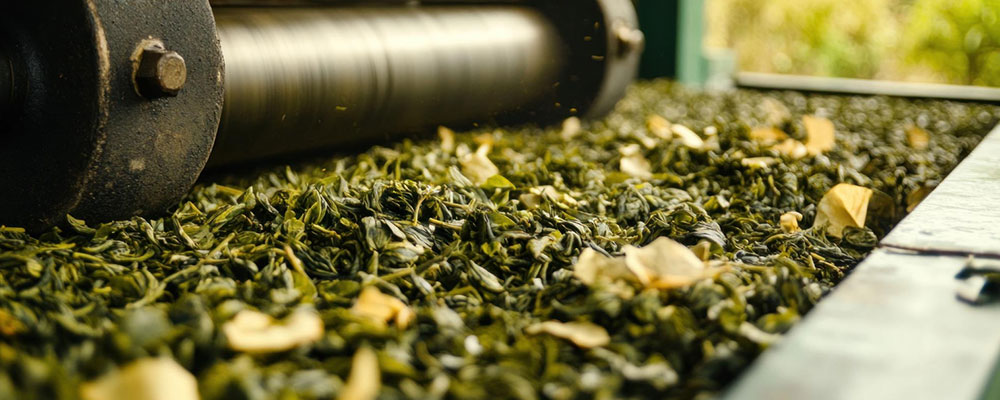
3. Rolling
Rolling mechanically disrupts leaf cells.
This allows enzymes and polyphenols that were previously separated within intact cells to come into contact.
As a result:
- Oxidation begins.
- Essential oils are released.
- Flavour precursors become available.
Proper rolling directly influences the efficiency of subsequent enzyme-driven reactions.
4. Oxidation
Oxidation represents the defining stage of black tea manufacture.
During this process:
- Catechins undergo enzymatic oxidation.
- Complex colour compounds develop.
- Characteristic tea aromas form.
- Flavour profiles mature.
Careful control of:
- Temperature
- Humidity
- Oxygen exposure
- Processing time
ensures consistent product quality.
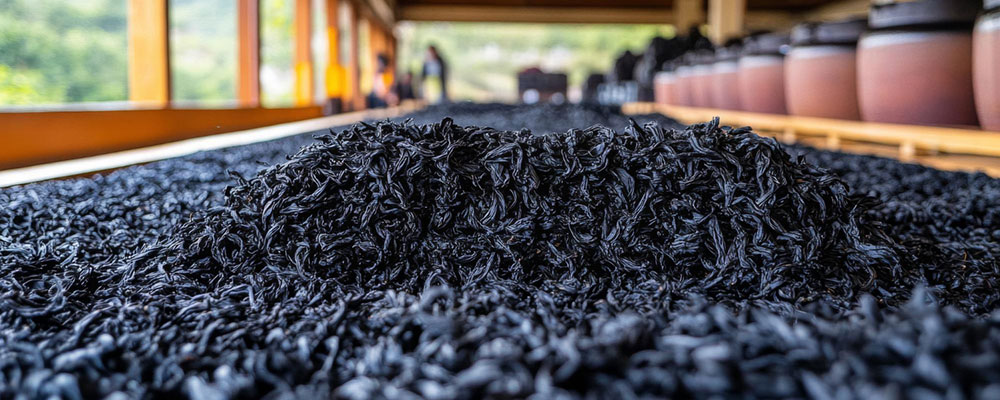
5. Drying
Drying stops enzymatic activity by reducing moisture content.
This stage:
- Stabilises flavour
- Preserves aroma
- Prevents over-oxidation
- Extends shelf life
Finished tea is then graded and prepared for packaging.
Biochemical Transformations During Oxidation
The oxidation stage involves several important chemical conversions.
Naturally occurring enzymes catalyse the transformation of simple catechins into larger compounds, including:
- Theaflavins
- Thearubigins
These compounds contribute to:
1. Colour Development
Theaflavins provide the bright golden-orange appearance of black tea liquor.
Thearubigins contribute a deeper reddish-brown colour and body.
2. Flavour Formation
Controlled oxidation produces:
- Rich malt notes
- Balanced astringency
- Smooth taste
- Complex flavour profiles
3. Aroma Development
Enzymatic reactions generate numerous volatile compounds responsible for the characteristic aroma of premium black tea.
Process Variables Influencing Enzyme Activity
Successful tea manufacturing depends upon maintaining optimum processing conditions.
1. Temperature
Temperature strongly influences enzyme activity. Excessive heat may reduce enzyme performance, while insufficient temperatures slow oxidation.
2. Humidity
Adequate moisture supports efficient biochemical reactions throughout oxidation.
3. Oxygen Availability
Oxygen is essential for polyphenol oxidation. Controlled airflow ensures uniform enzymatic activity across processing batches.
4. Processing Time
Insufficient oxidation may produce grassy flavours. Excessive oxidation may reduce brightness and aroma. Careful timing ensures balanced flavour development.
Benefits of Controlled Enzyme Processing
Modern tea manufacturers seek to optimise natural enzymatic activity through improved process control.
Benefits include:
- Consistent product quality
- Improved flavour development
- Better colour formation
- Enhanced aroma
- Uniform production
- Improved raw material utilisation
These improvements contribute to greater manufacturing efficiency while maintaining premium quality standards.
Sustainability in Modern Tea Manufacturing
Sustainability has become increasingly important throughout the tea industry.
Process optimisation supported by enzyme technology contributes through:
- Reduced production waste
- Improved raw material utilisation
- Lower energy consumption
- Better process consistency
- Improved manufacturing efficiency
These advantages support environmental objectives while improving operational performance.
Industrial Enzymes Beyond Tea Processing
The importance of enzyme technology extends well beyond tea manufacturing.
Industrial enzymes have become essential tools across numerous sectors.
1. Enzymes for Baking
Commercial baking relies heavily on specialised enzyme systems.
Applications include:
- Dough conditioning
- Increased loaf volume
- Improved crumb texture
- Better dough handling
- Extended product freshness
These improvements support consistent production quality and manufacturing efficiency.
2. Enzymes for Dairy Processing
The dairy industry employs enzymes throughout numerous production stages.
Applications include:
- Lactose hydrolysis
- Cheese manufacture
- Protein modification
- Texture optimisation
- Yield improvement
- Flavour development
These technologies improve product quality while increasing operational efficiency.
3. Enzymes for the Detergent Industry
Modern detergent formulations combine several enzyme classes.
These include:
- Proteases
- Lipases
- Amylases
- Cellulases
Together they remove:
- Protein stains
- Food residues
- Oils
- Starch deposits
Their effectiveness at lower washing temperatures contributes to reduced energy consumption.
4. Enzymes for the Textile Industry
Textile manufacturing increasingly incorporates enzyme technology to replace conventional chemical treatments.
Applications include:
- Desizing
- Bio-polishing
- Denim finishing
- Fabric softening
- Fibre preparation
These processes improve fabric quality while reducing chemical consumption and wastewater generation.
5. Enzymes for the Feed Industry
Feed enzymes improve nutrient availability by breaking down complex feed ingredients.
Benefits include:
- Better digestibility
- Improved feed conversion efficiency
- Reduced nutrient losses
- Enhanced livestock productivity
- Improved feed utilisation
These advantages support sustainable animal production.
6. Enzymes for Water Treatment
Industrial wastewater treatment increasingly uses biological enzyme solutions.
Applications include:
- Organic matter degradation
- Biofilm management
- Sludge reduction
- Wastewater treatment
- Odour control
Enzyme-assisted systems improve biological treatment performance while supporting environmental compliance.
7. Enzymes for Sugar Mills
Sugar manufacturers also benefit from enzyme technology.
Applications include:
- Juice clarification
- Reduced viscosity
- Improved extraction
- Enhanced filtration
- Increased sugar recovery
- Better process stability
These improvements contribute to greater manufacturing efficiency.
Emerging Innovations in Industrial Enzyme Technology
Industrial biotechnology continues to evolve through advances in enzyme discovery, fermentation and formulation.
Future developments are expected to focus on:
- Improved enzyme stability
- Enhanced catalytic efficiency
- Broader operating conditions
- Tailor-made enzyme formulations
- Greater compatibility with automated manufacturing systems
- Improved sustainability performance
These innovations will continue expanding the role of enzymes across food processing and industrial manufacturing.
The Strategic Value of Enzyme Technology Across Industries
Enzyme technology has become an important component of modern industrial strategy. By enabling precise biochemical reactions, enzymes allow manufacturers to optimise production processes while reducing dependence on aggressive chemical treatments and excessive resource consumption.
Across industries, enzyme technology supports:
- Improved operational efficiency
- Better product consistency
- Reduced energy consumption
- Lower environmental impact
- Improved raw material utilisation
- Enhanced manufacturing reliability
These advantages make enzyme-based processing increasingly valuable as industries pursue operational excellence and sustainable growth.
Conclusion
The transformation of fresh tea leaves into premium black tea depends upon a carefully managed series of enzymatic reactions that shape the beverage’s colour, flavour, aroma and overall quality. By understanding and optimising these natural biochemical processes, manufacturers can achieve greater consistency, improve raw material utilisation and produce black tea that meets the high expectations of global consumers. As processing technologies continue to evolve, enzyme-based approaches will remain central to achieving efficient and sustainable tea production.
The benefits of industrial enzymes extend far beyond tea manufacturing. Similar technologies continue to improve commercial baking, dairy production, detergent formulation, textile processing, animal nutrition, wastewater treatment and sugar manufacturing by enhancing process efficiency, product quality and environmental performance across diverse industries.
Biolaxi Enzymes supports these evolving industrial requirements through a comprehensive portfolio of specialised enzyme solutions developed for tea processing and a wide range of industrial applications. By combining technical expertise, application-focused innovation and consistent product quality, Biolaxi Enzymes helps manufacturers optimise production processes, address operational challenges and achieve reliable, sustainable manufacturing outcomes across multiple sectors.