
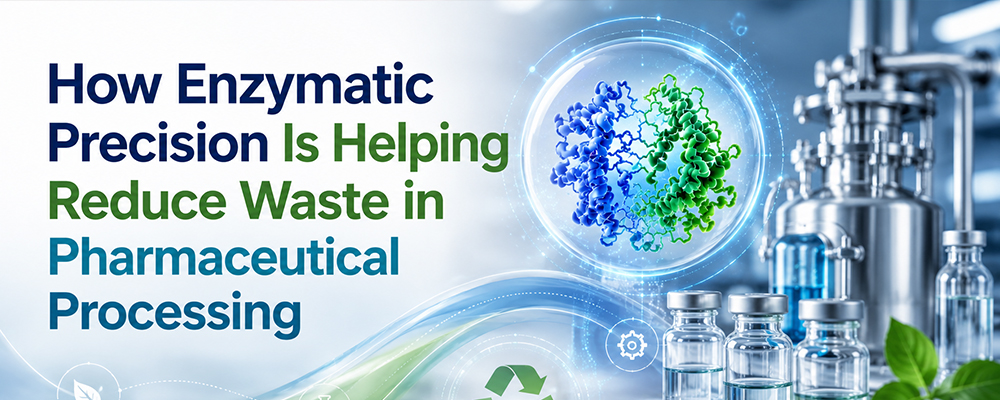
Pharmaceutical processing is under growing pressure to balance production efficiency with environmental responsibility. As regulatory expectations become stricter and sustainability goals gain greater importance, reducing waste has become a major operational priority across the pharmaceutical sector. Processing facilities are now expected to maintain product quality and regulatory compliance while also lowering resource consumption, solvent usage and waste generation.
Traditional pharmaceutical synthesis often involves complex reaction pathways, multiple purification stages and intensive chemical processing. While these systems have supported large scale production for years, they can also generate significant waste in the form of residual solvents, unwanted by products, aqueous effluents and rejected batches.
This is where enzymatic precision is creating meaningful change. Enzymes help optimise pharmaceutical reactions with greater selectivity and control, reducing unnecessary waste formation at the source rather than relying solely on downstream treatment systems. Their ability to support cleaner and more efficient reactions is helping pharmaceutical processing move towards more sustainable operational models.
Understanding Waste Generation in Pharmaceutical Processing

Pharmaceutical waste is generated at multiple stages of production. It is not limited to expired products or discarded materials. A large portion originates during synthesis itself through inefficient reactions, excess solvent use and complex purification requirements.
Common waste sources include:
- Spent solvents
- Residual catalysts
- Reaction by products
- Off specification batches
- Excess reagent consumption
- Contaminated aqueous streams
Managing these waste streams increases operational costs and places additional pressure on treatment infrastructure.
For pharmaceutical processing facilities operating under strict environmental regulations, reducing waste generation at the process stage has become increasingly important.
The Role of Enzymes in Pharmaceutical Applications
Enzymes are biological catalysts that accelerate highly specific chemical reactions. Unlike conventional chemical catalysts, enzymes operate with exceptional precision and target only desired molecular transformations.
This specificity makes them highly valuable in pharmaceutical processing, where even small reaction deviations can affect purity, yield and product consistency.
Enzymes are commonly used for:
- Selective synthesis reactions
- Controlled hydrolysis processes
- Chiral compound resolution
- Intermediate compound production
- Fermentation related applications
Because enzymes work selectively, they help minimise unwanted side reactions that often contribute to waste generation.
Enzymatic Catalysis as a Preventive Waste Reduction Strategy
Traditional waste management approaches typically focus on treating waste after it has already been generated. Enzymatic catalysis takes a different approach. It reduces waste formation during the reaction itself.
By improving reaction efficiency and molecular selectivity, enzymes help create cleaner synthesis pathways with fewer unnecessary by products. This preventive model significantly reduces downstream waste handling requirements.
The advantages include:
- Lower impurity formation
- Reduced solvent intensive purification
- Better raw material utilisation
- Improved reaction efficiency
- Reduced processing losses
Preventing waste at its origin is often more efficient than managing large waste streams later in the process.
Improving Selectivity and Product Yield
Selectivity is one of the greatest strengths of enzyme based systems. In conventional synthesis, chemical catalysts may generate multiple reaction products simultaneously. This creates complicated mixtures that require additional purification and separation.
Enzymes guide reactions along more controlled pathways. Their precision supports higher yields of the desired pharmaceutical compound while limiting unwanted molecular variations.
This can help achieve:
- Higher conversion efficiency
- Reduced by product generation
- Improved product purity
- Lower rejection rates
- Better process consistency
Cleaner reactions directly contribute to lower waste volumes.
Reducing Solvent Usage and Effluent Load
Solvents account for a significant percentage of pharmaceutical waste. Their disposal, treatment and recovery require considerable operational resources and environmental management.
Enzymatic reactions often function effectively with reduced solvent dependency or under water based conditions. This helps simplify reaction systems while lowering solvent consumption.
Potential benefits include:
- Reduced solvent waste
- Lower effluent generation
- Simplified wastewater treatment
- Improved environmental performance
- Better process sustainability
For processing facilities facing water and waste management pressures, these improvements are especially valuable.
Supporting Safer and Cleaner Processing Conditions
Many traditional pharmaceutical reactions rely on harsh chemicals, heavy metal catalysts or extreme operating conditions. These systems may increase hazardous waste generation and create additional handling risks.
Enzymes provide a cleaner alternative. Since they operate under milder temperatures and controlled pH conditions, they help reduce dependence on aggressive processing environments.
This contributes to:
- Reduced hazardous residue generation
- Improved operational safety
- Lower environmental burden
- Better process control
- Simplified handling requirements
Milder processing conditions also support improved stability for sensitive pharmaceutical compounds.
The Importance of Immobilised Enzyme Systems
Immobilised enzymes are increasingly important in pharmaceutical processing. In these systems, enzymes are attached to solid supports and reused across multiple production cycles.
This approach improves process efficiency while reducing material consumption.
Advantages may include:
- Reusable catalytic systems
- Reduced enzyme replacement frequency
- Better reaction consistency
- Lower catalyst waste
- Improved operational stability
Reusable enzyme systems also help reduce batch variability and minimise waste associated with process inconsistencies.
Supporting Sustainable Pharmaceutical Operations
Sustainability is becoming central to pharmaceutical processing strategies. Regulatory expectations, investor priorities and environmental responsibility initiatives are all driving demand for cleaner production systems.
Enzymatic processing supports these objectives through:
- Lower waste generation
- Reduced energy consumption
- Improved resource efficiency
- Reduced solvent dependency
- Better environmental compatibility
As green chemistry principles become more important, enzymes are playing a larger role in helping pharmaceutical operations align with long term sustainability goals.
Driving Innovation in Pharmaceutical Processing
Enzyme technologies continue to evolve rapidly. Improved stability, broader substrate compatibility and highly specialised formulations are expanding pharmaceutical applications significantly.
Current innovation areas include:
- Enhanced catalytic precision
- More efficient synthesis pathways
- Improved operational flexibility
- Better compatibility with complex compounds
- Greater process optimisation capabilities
These developments are helping pharmaceutical processing become more efficient, controlled and environmentally responsible.
Conclusion
Reducing waste in pharmaceutical processing requires a shift from reactive waste treatment towards smarter process design. Enzymatic precision supports this transition by improving reaction selectivity, reducing unnecessary by products and enabling cleaner synthesis pathways. Through more controlled and efficient reactions, enzymes help pharmaceutical processing operations lower waste generation while improving consistency and operational performance.
Biolaxi Enzymes supports pharmaceutical processing facilities with carefully developed enzyme solutions designed to improve reaction efficiency, reduce process waste and support sustainable pharmaceutical operations. With strong research expertise, customised enzyme capabilities and a focus on practical industrial applications, Biolaxi Enzymes helps the pharmaceutical sector move towards cleaner, more efficient and environmentally responsible processing systems.