
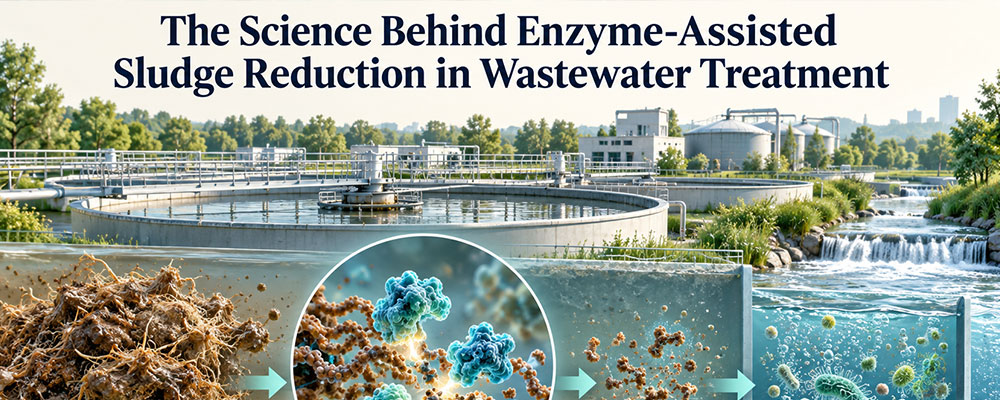
Wastewater treatment is increasingly being evaluated not only on its ability to remove contaminants, but also on how efficiently it manages the secondary waste generated during treatment. Sludge is one of the most significant operational challenges in this regard. It contains concentrated organic and inorganic matter, microbial biomass, and substantial quantities of water, making handling, dewatering, transportation, and disposal resource-intensive activities. Conventional approaches can be effective, but they may involve considerable chemical consumption and energy requirements. Enzyme-assisted treatment offers another route by targeting complex organic matter and extracellular polymeric substances at a biochemical level. By improving the breakdown of difficult substrates and altering sludge structure, appropriately selected enzymes can support better sludge reduction, degradation, and dewaterability. Recent research also highlights enzyme-assisted conditioning as an emerging approach within broader microbial and hybrid sludge-management strategies.
Why Sludge Management Remains a Critical Treatment Challenge
Sludge is an unavoidable by-product of many biological and physicochemical wastewater treatment processes. While treatment removes pollutants from the liquid stream, these contaminants are frequently transferred into a concentrated solid or semi-solid phase.
For treatment plant operators, the challenge extends well beyond the generation of sludge itself. Large quantities of sludge can increase:
- Storage and handling requirements
- Dewatering and drying costs
- Transportation volumes
- Chemical consumption for conditioning
- Energy demand
- Disposal or further-treatment requirements
The characteristics of sludge vary substantially depending on the source of wastewater and the treatment process. Municipal sewage sludge differs from sludge generated by food processing, textiles, pharmaceuticals, chemicals, paper manufacturing and other industrial operations.
This variability is one reason why sludge treatment cannot rely on a single universal intervention. Effective treatment requires an understanding of the organic composition, microbial population, solids concentration, pH, temperature and physical structure of the sludge.
Understanding What Holds Water Inside Sludge

One of the less visible challenges in sludge management is the difference between free water and water that is strongly associated with the sludge matrix.
Microbial aggregates within activated sludge produce extracellular polymeric substances, commonly referred to as EPS. These substances form a hydrated, three-dimensional matrix around microbial cells and contribute to the structure and characteristics of sludge flocs. EPS can influence flocculation, settleability and dewatering behaviour because of its capacity to retain water.
This distinction is important because conventional mechanical dewatering primarily removes water that is relatively easy to separate. A portion of the remaining water can be more strongly associated with the cellular and polymeric structure of the sludge.
Recent research on sludge dewatering identifies EPS-associated bound water as a significant technical challenge and examines enzymatic conditioning as one possible method for modifying this structure.
The scientific rationale for enzyme-assisted sludge treatment therefore begins with a simple principle: changing the biochemical structure of the sludge matrix can influence how readily water and organic matter can be separated.
How Enzymes Interact with Complex Organic Matter
Enzymes are biological catalysts capable of accelerating specific biochemical reactions. In wastewater treatment, hydrolytic enzymes are particularly relevant because many organic compounds present in sludge are too large or structurally complex to be directly utilised efficiently by microorganisms.
Hydrolysis helps break these larger molecules into smaller compounds. This can make organic substrates more accessible for subsequent biological degradation.
Research on sludge treatment has long recognised the importance of hydrolytic enzymes in the breakdown of polymeric organic matter. Their effectiveness, however, depends on factors such as pH, temperature, substrate accessibility, mass transfer and the characteristics of the sludge matrix.
Depending on the wastewater composition, enzyme activities may act on substrates such as:
- Proteins
- Fats and lipids
- Starch and other carbohydrates
- Cellulosic materials
- Other biodegradable organic polymers
This substrate specificity is central to the value of enzyme-based treatment. Rather than attempting to alter all organic material indiscriminately, a suitable enzyme system can be selected to target particular components of the wastewater or sludge.
From Organic Breakdown to Sludge Reduction
Sludge reduction does not simply mean making the sludge disappear. At process level, reduction may involve several interconnected mechanisms.
First, enzymes can promote hydrolysis of complex organic materials. As larger molecules are converted into smaller compounds, these substrates may become more accessible to microbial communities.
Second, enzymatic modification of extracellular polymers may affect the structure of sludge flocs. This can influence how water is retained and how readily solids respond to subsequent dewatering operations.
Third, improved biodegradation can reduce the mass of biodegradable organic matter remaining in the sludge under appropriate process conditions.
The precise outcome depends heavily on the treatment system. It would therefore be misleading to assume that an enzyme formulation will always produce the same percentage reduction across different plants.
Recent literature specifically notes that performance observed in laboratory-scale work does not necessarily translate directly to full-scale operations. Sludge characteristics, operating conditions and interactions with existing treatment processes can materially affect results.
Enzyme-Assisted Dewatering and the Importance of Sludge Structure
Dewatering is often one of the most demanding stages of sludge management. Mechanical systems such as centrifuges, belt presses and filter presses are designed to separate water from solids, but their performance depends strongly on the physical and chemical characteristics of the sludge entering the equipment.
A sludge with a highly hydrated polymeric structure can resist water release. Enzymatic conditioning aims to modify some of these structures before or alongside dewatering.
The potential process sequence can be viewed as:
Complex organic matter → enzymatic hydrolysis → structural modification → improved water release → more efficient dewatering
This does not mean enzymes replace mechanical dewatering equipment. Rather, they can be considered as a conditioning step intended to improve the behaviour of sludge during downstream separation.
Key indicators used to evaluate dewatering performance can include:
- Capillary suction time
- Specific resistance to filtration
- Dry solids content
- Filtration and drainage behaviour
- Changes in EPS fractions
- Sludge settling and floc characteristics
These measurements provide a more meaningful assessment than relying solely on visual changes in sludge appearance. Recent research recommends combining such indicators to understand how changes in sludge microstructure translate into dewatering performance.
Matching Enzyme Activity to the Wastewater Profile
The selection of an enzyme should begin with the composition of the wastewater rather than with the name of a particular enzyme.
For example, a food-processing effluent containing substantial protein and fat loads presents a different enzymatic opportunity from a textile wastewater containing primarily carbohydrate-based sizing materials or other textile-processing residues.
Several variables should therefore be assessed before implementation:
1. Organic Load
The concentration and composition of biodegradable organic matter determine which enzyme activities may be useful.
2. pH
Enzymes have defined operating ranges. Treatment chemistry outside that range can reduce activity or stability.
3. Temperature
Reaction rates and enzyme stability are both influenced by temperature. The formulation must be suitable for the actual wastewater-treatment environment.
4. Hydraulic and Retention Conditions
The available reaction time affects the extent to which an enzymatic process can influence the substrate.
5. Sludge Characteristics
The solids concentration, floc structure, EPS composition and particle size can influence enzyme accessibility.
6. Existing Treatment Chemistry
Coagulants, disinfectants, oxidising agents and other chemicals can interact with biological treatment systems and may affect enzyme performance.
A technically sound approach therefore requires application testing under representative operating conditions rather than assuming that a laboratory specification will automatically deliver the same result at full scale.
Industrial Wastewater: Where Application Specificity Matters Most
Industrial wastewater can be considerably more variable than domestic sewage. Manufacturing processes may generate wastewater with high organic loads, unusual pH profiles, oils, suspended solids, starches, proteins or other specific compounds.
This makes industrial enzyme technology particularly relevant where a clearly defined organic substrate is contributing to treatment difficulties.
1. Food and Beverage Processing
Wastewater from food manufacturing can contain proteins, carbohydrates and fats that contribute substantially to organic loading. Enzymatic hydrolysis can support the breakdown of selected substrates before or within biological treatment.
2. Textile Processing
Textile operations can generate wastewater containing sizing agents, fibres, processing chemicals and organic residues. Enzymes are already used upstream in textile processes for applications such as desizing and bioscouring, demonstrating the broader relevance of targeted biological processing within the textile value chain. Biolaxi identifies alpha-amylase for desizing and bioscouring enzymes among its textile applications.
3. Pulp and Paper
Pulp and paper operations generate streams containing fibres, carbohydrates and other organic materials. Enzymatic approaches can be used in several stages of fibre processing and may complement broader biological treatment strategies.
4. Chemical and Other Manufacturing Operations
Where wastewater composition is complex, enzyme treatment may be most useful as part of a broader process rather than as a standalone solution. The objective is to identify specific organic constituents that can be biologically transformed and determine where enzymatic treatment can create measurable process value.
Enzyme Applications Extend Across the Manufacturing Ecosystem
The scientific principles behind enzyme-assisted wastewater treatment are closely related to enzyme applications in other industries.
1. Tea Processing
Tea-processing systems contain plant-derived compounds and cell-wall components that can affect extraction, clarification and product characteristics. Pectinase and related enzyme systems can support selected processing operations by acting on structural polysaccharides.
2. Dairy Processing
Dairy processing provides another example of targeted enzyme application. Lactase, for instance, hydrolyses lactose and is used in the production of lactose-reduced or lactose-free dairy products.
3. Detergent Manufacturing
The wastewater generated by detergent and cleaning-product operations can contain surfactants and organic materials with varying degrees of biodegradability. Enzymatic treatment strategies can be considered where specific biodegradable substrates are contributing to the organic load.
4. Animal Feed
Feed manufacturing and livestock nutrition rely on enzymes such as protease, phytase and carbohydrases to improve nutrient utilisation. These applications demonstrate the broader industrial principle of using specific biological catalysts to make complex raw materials more accessible.
5. Sugar Mills
Sugar manufacturing can encounter process-related organic polymers such as dextran, as well as starch and other compounds that can interfere with processing. Enzymes such as dextranase are used in suitable sugar-processing applications to target these compounds selectively.
Across these sectors, the commercial objective is similar: identify a specific process limitation and use biochemical activity to address it with greater selectivity.
The Role of Enzymes in a More Integrated Treatment Strategy
The greatest value of enzyme-assisted treatment may come not from replacing existing wastewater infrastructure, but from complementing it.
A modern treatment system can involve several stages:
Screening and primary separation → biological treatment → enzymatic conditioning or treatment → clarification → sludge dewatering → final disposal or recovery
The exact configuration depends on the plant.
Enzymes may be introduced at a point where they can improve the breakdown of organic matter, assist conditioning or support the performance of downstream biological or physical processes.
Biolaxi’s wastewater-treatment portfolio describes specific enzyme-based approaches intended to improve waste degradation and reduce sludge volume in industrial and municipal wastewater applications.
This positioning is particularly relevant where wastewater operators are seeking to optimise an existing treatment system rather than invest immediately in entirely new infrastructure.
Evaluating the Business Case Beyond Enzyme Dosage
For enterprise decision makers, the economics of an enzyme programme should not be evaluated simply by comparing the cost per kilogram of enzyme.
A more useful assessment considers the overall treatment economics.
Important parameters include:
- Reduction in sludge volume or biodegradable solids
- Improvement in dewatering performance
- Lower polymer or conditioning chemical requirements
- Reduced transportation and disposal volumes
- Changes in energy consumption
- Impact on biological treatment stability
- Improvements in treated-water quality
- Operational consistency over time
A properly designed plant trial should establish a baseline first and then compare performance after controlled enzyme application.
This is particularly important because wastewater systems are dynamic. Variations in production schedules, raw materials, wastewater strength, temperature and biological activity can all affect results.
The Importance of Application Trials and Process Validation
Enzyme-assisted treatment should be validated under realistic operating conditions before large-scale adoption.
A structured trial may include:
- Characterisation of influent and sludge composition.
- Identification of the dominant organic substrates.
- Selection of potentially suitable enzyme activities.
- Laboratory screening and dosage optimisation.
- Pilot or controlled plant trials.
- Measurement of sludge volume, solids content and dewatering performance.
- Economic assessment against the existing process.
- Long-term monitoring for consistency.
This approach reduces the risk of treating enzyme technology as a theoretical solution without confirming its practical relevance.
Biolaxi states that its R&D team evaluates customer processes, provides recommendations and conducts application trials to determine suitable enzyme performance.
Such application-focused development is important because successful industrial biotechnology depends on integrating the biological component with the engineering realities of the treatment plant.
Looking Ahead: More Targeted and Resource-Efficient Sludge Management
Wastewater treatment is increasingly moving towards resource efficiency, process optimisation and reduced environmental impact. Within this broader transition, enzymes represent one avenue for more targeted biological intervention.
Future development is likely to focus on improving enzyme stability, substrate specificity, compatibility with challenging process conditions and integration with biological and mechanical treatment systems.
Hybrid approaches may be particularly significant. Recent research is examining combinations of microbial, enzymatic, chemical and physical methods to improve bound-water release and dewatering while managing chemical and energy requirements.
This suggests that the future of enzyme-assisted sludge management is unlikely to be based on a single universal formulation. Instead, the emphasis will be on understanding each wastewater system and designing an appropriate treatment strategy around its chemistry, microbiology and operating conditions.
Conclusion
Sludge reduction is ultimately a process-engineering challenge supported by biological science. Enzymes can contribute by accelerating the breakdown of complex organic matter and modifying components of the sludge matrix that influence biodegradation and water retention. Their potential value is particularly relevant where conventional treatment is constrained by high organic loads, difficult sludge characteristics or the cost of downstream dewatering and disposal.
The most effective approach is not to regard enzymes as a replacement for established wastewater-treatment systems, but as targeted tools that can complement biological, chemical and mechanical processes. Their success depends on selecting appropriate enzyme activities, understanding the wastewater profile, controlling operating conditions and validating performance through application trials.
Biolaxi Enzymes addresses these requirements through enzyme solutions for wastewater treatment alongside applications spanning detergents, textiles, feed, dairy, tea processing and other industrial sectors. Its emphasis on process evaluation, R&D and application trials provides a practical basis for adapting enzyme technology to specific industrial requirements.
As wastewater management becomes increasingly focused on efficiency, resource recovery and responsible waste handling, enzyme-assisted treatment has the potential to become a valuable component of integrated sludge-management strategies. The central opportunity lies not simply in reducing sludge, but in making the entire treatment process more controlled, efficient and fit for the operational demands of modern industry.