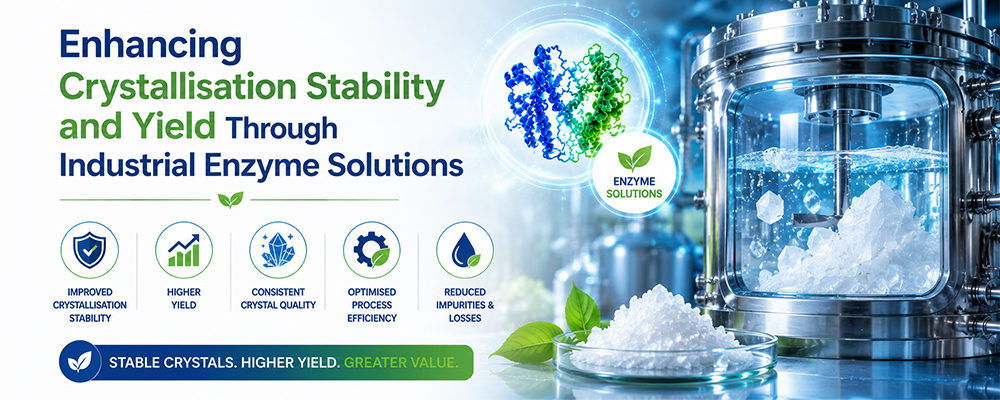
Crystallisation is one of the most important stages in sugar processing. It determines not only the quantity of sugar recovered from cane juice but also the quality, purity and commercial value of the final product. Stable crystal formation allows sugar operations to achieve better recovery, smoother downstream handling and more consistent product quality. However, maintaining this stability is often challenging because sugar processing involves a highly complex mixture of organic compounds, fibres, starches and colloidal impurities that continuously influence process performance.
In many sugar operations, inefficiencies during crystallisation lead to reduced recovery, excessive molasses losses, inconsistent crystal size and operational instability. Even when juice clarification and evaporation appear effective, residual impurities can continue interfering with sucrose crystallisation at later stages. This is why sugar processing facilities are increasingly adopting industrial enzyme solutions to improve process control and maximise yield.
Industrial enzymes offer a more targeted and process oriented approach. Instead of relying only on aggressive chemical correction or excessive thermal treatment, enzymes act directly on the compounds responsible for viscosity, impurity build up and crystallisation interference. Their selective action helps create cleaner processing conditions throughout the sugar production cycle.
Why Crystallisation Stability Is Critical in Sugar Processing
Crystallisation is the stage where dissolved sucrose transforms into solid sugar crystals. The success of this transformation depends on maintaining the right balance between supersaturation, purity, temperature and viscosity.
When crystallisation conditions become unstable, several operational problems can emerge. Crystal growth may become uneven. Fine crystals may form excessively. Massecuite handling becomes difficult due to higher viscosity, and sugar recovery rates may decline.
These issues often result in:
- Lower crystal purity
- Increased molasses retention
- Irregular crystal size distribution
- Reduced sugar recovery efficiency
- Higher operational losses
- Increased reprocessing requirements
In large scale sugar operations, these inefficiencies directly affect profitability and production consistency. Maintaining stable crystallisation therefore becomes essential not only for product quality but also for operational efficiency.
Understanding the Impact of Non Sugar Impurities
Raw sugarcane juice contains far more than sucrose alone. It naturally carries a wide range of non sugar compounds including starch, pectins, proteins, waxes, fibres, gums and inorganic particles. During extraction and clarification, not all these impurities are completely removed.
Residual impurities create multiple processing challenges. Some compounds increase juice viscosity, while others interfere with heat transfer, filtration and crystal nucleation. Certain polysaccharides may even coat developing sugar crystals, preventing uniform crystal growth.
As impurity concentration rises, crystallisation becomes increasingly difficult to control. This can lead to slower crystal development, poor crystal separation and reduced sugar recovery.
Traditional clarification systems help reduce part of this load, but conventional chemical treatment alone may not fully address the biochemical complexity of cane juice. Industrial enzymes help bridge this gap through targeted molecular breakdown of problematic compounds.
How Industrial Enzymes Improve Sugar Processing
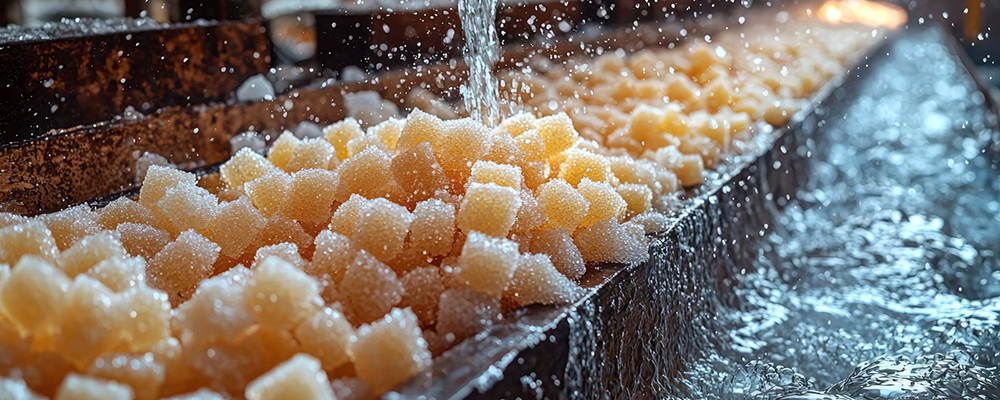
Industrial enzymes function as highly selective biological catalysts. Unlike general chemical additives, enzymes target specific substrates without damaging sucrose molecules themselves.
Different enzyme systems perform different roles during sugar processing:
- Amylases hydrolyse starch molecules that increase viscosity and interfere with filtration
- Pectinases break down pectic substances that contribute to turbidity and unstable flow behaviour
- Cellulases and hemicellulases degrade fibrous plant material and release trapped sucrose
- Proteases reduce protein related colloidal interference and help improve process clarity
This targeted activity improves the physical and chemical behaviour of cane juice before it reaches the crystallisation stage.
Rather than acting as temporary corrective agents, enzymes improve the overall processing environment from extraction through final sugar recovery.
Improving Juice Flow and Viscosity Control
One of the major barriers to stable crystallisation is excessive viscosity. Thick and poorly flowing syrup restricts sucrose mobility, making crystal growth uneven and inefficient.
Industrial enzymes help reduce viscosity by breaking down high molecular weight polysaccharides and colloidal materials that create resistance within the juice system. Improved fluidity supports better circulation, more uniform heat transfer and smoother movement during evaporation and crystallisation.
Better viscosity control contributes to:
- Improved massecuite handling
- Faster crystal growth
- Better heat exchange efficiency
- Reduced stress on processing equipment
- More stable operational performance
These improvements become especially important during high throughput production periods.
Supporting Better Crystal Formation and Recovery
Crystallisation performance depends heavily on how freely sucrose molecules can migrate and attach to growing crystal surfaces. When impurities interfere with this movement, crystal growth becomes inconsistent.
Enzyme supported clarification and viscosity reduction create more favourable conditions for crystal nucleation and development. Cleaner syrup allows crystals to grow more uniformly while reducing interference from suspended colloids and polysaccharides.
This contributes to:
- Improved crystal uniformity
- Better crystal brightness
- Higher crystal purity
- Reduced formation of false grain
- Improved centrifugal separation
- Higher overall sugar recovery
Even modest improvements in recovery can generate significant economic benefits for large sugar operations over an entire crushing season.
Reducing Operational Challenges Across Processing Stages
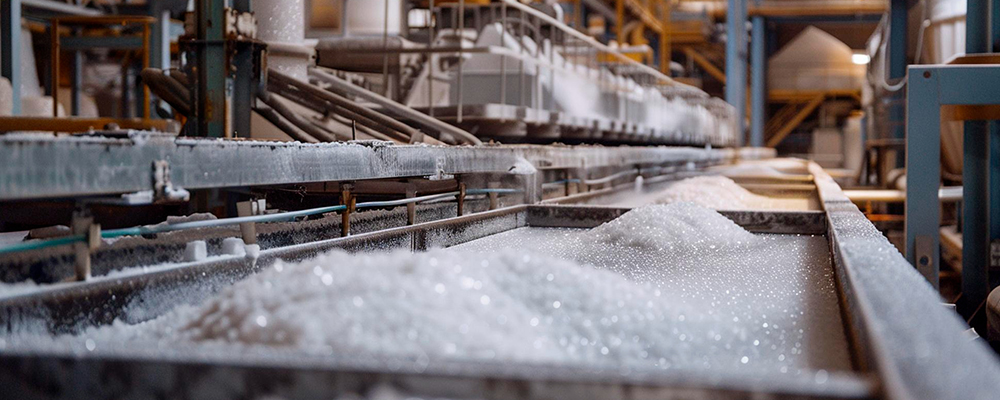
The benefits of industrial enzyme solutions extend well beyond crystallisation alone. By improving juice quality earlier in the process, enzymes help reduce operational stress across multiple production stages.
Cleaner and lower viscosity juice contributes to:
- Reduced scaling in evaporators
- Improved filtration performance
- Lower fouling in heat exchangers
- Reduced equipment cleaning frequency
- Better process consistency across batches
Reduced fouling is particularly valuable because scale accumulation lowers heat transfer efficiency and increases energy consumption. Frequent shutdowns for cleaning also reduce overall productivity.
By minimising impurity related complications, enzymes help sugar operations maintain smoother and more continuous processing conditions.
Supporting Sustainability and Resource Efficiency
Modern sugar operations are under increasing pressure to improve environmental performance while maintaining production efficiency. Industrial enzymes support these goals by helping reduce excessive chemical dependency and improving resource utilisation.
Because enzymes function effectively under moderate conditions, they may help reduce the need for intensive thermal processing and excessive clarification chemicals. Improved sugar recovery also means more efficient use of harvested cane.
Potential sustainability advantages include:
- Reduced chemical load in processing
- Lower wastewater treatment burden
- Improved raw material utilisation
- Reduced energy demand through cleaner processing
- Lower operational waste generation
These improvements support both environmental objectives and long term operational cost management.
Process Flexibility and Adaptability
Sugarcane quality can vary significantly depending on seasonal conditions, cane maturity and regional agricultural practices. Such variations often create processing instability.
Industrial enzyme systems provide greater flexibility because formulations can be adjusted based on process conditions and impurity profiles. Enzyme combinations may be customised according to:
- Juice composition
- Starch concentration
- Fibre content
- Processing temperature
- Desired recovery targets
This adaptability allows operations to maintain more stable processing performance even when raw material conditions fluctuate.
The Future of Enzyme Supported Sugar Processing
As sugar operations continue modernising, industrial enzymes are expected to play an even larger role in process optimisation. Ongoing advancements in enzyme development are improving substrate specificity, thermal stability and compatibility with industrial processing environments.
Future innovations are likely to focus on:
- Multi functional enzyme systems
- Improved performance under variable pH conditions
- Better integration with automated process control
- Greater efficiency in impurity degradation
- Enhanced support for sustainable sugar processing
The shift towards precision driven processing will continue increasing the value of enzyme based technologies across the sugar industry.
Conclusion
Stable crystallisation is essential for achieving higher sugar recovery, better crystal quality and improved operational efficiency. However, impurities such as starches, pectins and colloidal materials continue creating major challenges across sugar processing systems.
Industrial enzyme solutions help address these challenges through precise and targeted biochemical action. By improving juice clarity, reducing viscosity and supporting cleaner crystallisation conditions, enzymes contribute directly to higher yield and more reliable process performance.
Biolaxi Enzymes supports sugar operations with carefully developed industrial enzyme solutions designed to improve crystallisation stability, optimise processing efficiency and enhance sugar recovery. Through customised enzyme expertise, application focused support and scientifically developed formulations, Biolaxi Enzymes continues helping the sugar industry achieve more consistent, efficient and sustainable processing outcomes.