
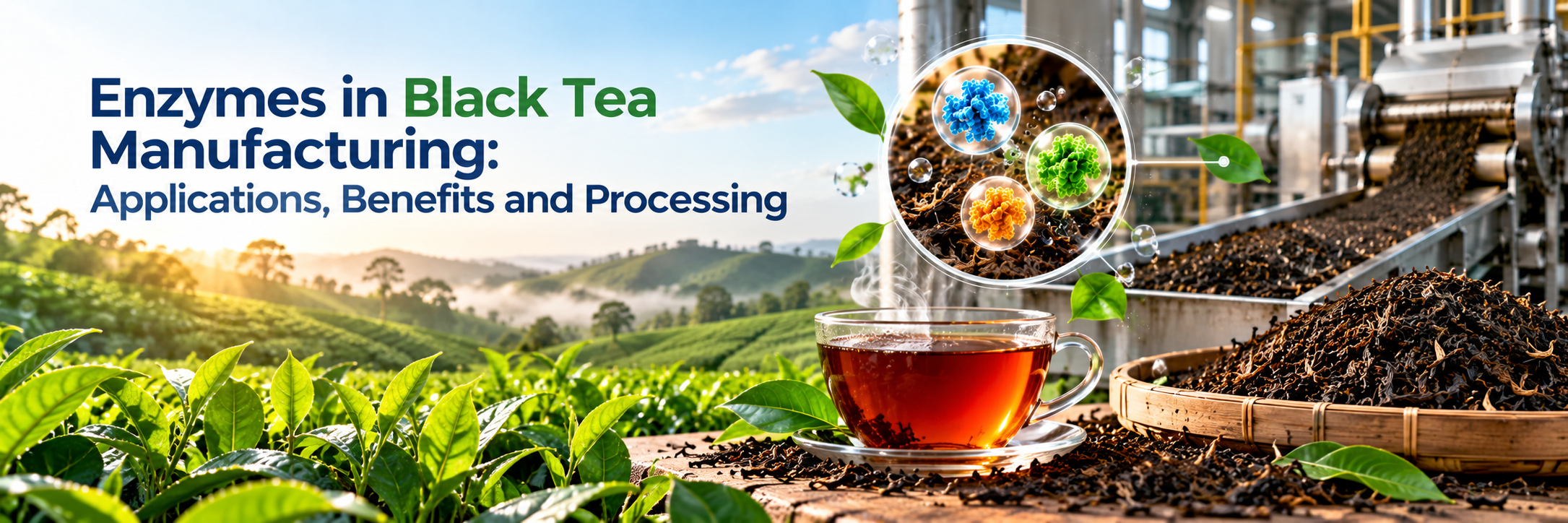
Black tea manufacturing is a carefully controlled sequence of biochemical and physical transformations that determines the final colour, aroma, flavour, briskness and overall cup quality of the product. The process typically involves withering, rolling or maceration, oxidation commonly referred to as fermentation, drying and grading. During these stages, naturally occurring enzymes in the tea leaf drive important biochemical reactions, particularly the oxidation of catechins into theaflavins and thearubigins. At the same time, the structure of the tea leaf influences how efficiently intracellular compounds are released and transformed. Enzyme technology provides an additional way of influencing selected processing reactions by acting on cell-wall materials and other substrates. Pectinases, cellulases and related enzyme systems have been investigated for their ability to improve extraction, support oxidation and influence important quality parameters in black tea.
For modern tea processors, the significance of enzyme technology is not simply higher extraction or faster processing. The more important consideration is whether a carefully selected enzyme system can improve process control while maintaining the sensory and compositional characteristics expected from a consistent black tea product.
The Biochemical Foundation of Black Tea Manufacture
Fresh tea leaves contain a complex mixture of catechins, polyphenols, amino acids, carbohydrates, enzymes and volatile precursors. Once the leaf is harvested, processing begins to alter this composition.
Withering reduces moisture and changes the physical and biochemical condition of the leaf. Rolling or maceration then disrupts cellular structures, bringing enzymes and substrates into closer contact. During oxidation, endogenous polyphenol oxidase and peroxidase participate in the transformation of catechins into compounds that contribute substantially to black tea colour and character. Drying eventually stops most of these enzymatic reactions by applying heat and reduces the moisture content to a level suitable for storage.
The controlled progression of these reactions matters because excessive or insufficient oxidation can affect the balance of theaflavins, thearubigins and other compounds responsible for liquor characteristics.
This is where processing precision becomes important. Enzyme-assisted processing does not seek to replace the natural biochemical system of the tea leaf. Instead, it can be used to modify specific structural barriers or processing conditions so that naturally occurring reactions can proceed more effectively.
Why the Tea Leaf Structure Matters
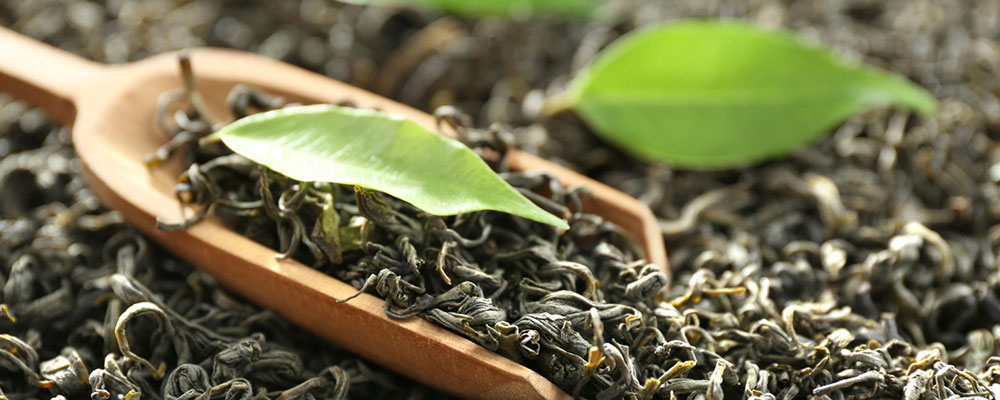
Tea leaves contain cell walls composed of structural polysaccharides, including pectin, cellulose and hemicellulose. These components contribute to the integrity of the leaf and can act as physical barriers that limit the release of intracellular compounds during processing.
For manufacturers, the ability to access these compounds efficiently is important because many of the substances that contribute to liquor quality are located within the leaf tissue.
Pectinase, cellulase and related carbohydrases can act on components of the plant cell wall. By partially breaking down these structural materials, enzymatic treatment can increase the accessibility of compounds that participate in subsequent processing reactions.
Research into enzymatic black tea processing has shown that treatment involving cellulase, polyphenol oxidase and peroxidase can alter tea composition and quality characteristics. One study reported increases in parameters including total liquor colour, theaflavins and thearubigins following specific enzyme-assisted processing conditions.
The objective, however, should be controlled modification rather than maximum cell-wall degradation.
Pectinase and Its Role in Tea Processing
Pectin is a complex polysaccharide found in plant cell walls and middle lamellae. Pectinase refers to a group of enzymes capable of breaking down different forms of pectic substances.
In tea processing, pectinase can contribute to improved access to intracellular materials by modifying the structural matrix around plant cells. This has potential implications for oxidation, extractability and liquor characteristics.
A research study evaluating enzymatic treatment of black tea reported that pectinase treatment improved extractable-solids yield, while other enzyme treatments affected the recovery of polyphenolic compounds and the balance between tea pigments.
Biolaxi’s tea-processing enzyme is described as a food-grade formulation combining pectinase and hemicellulase from selected fungal sources. The company positions the formulation for breaking down cell-wall material during tea processing and reports potential effects on theaflavin, thearubigin and total liquor-colour parameters.
For an industrial processor, the relevance of pectinase therefore lies in its ability to influence the physical accessibility of compounds within the tea leaf rather than simply acting as a generic processing aid.
Cellulase, Hemicellulase and Improved Substrate Accessibility
Cellulose and hemicellulose provide structural strength to plant tissues. Enzymes acting on these materials can alter the physical structure of tea leaves and improve the release of soluble compounds during processing.
Experimental studies have examined cellulase, pectinase and xylanase as part of enzymatic approaches to black tea manufacture. Research has reported changes in theaflavin, thearubigen, total liquor colour, total soluble solids and other quality indicators following treatment with cell-wall-degrading enzymes.
The commercial importance of this approach is linked to extraction efficiency.
When more of the relevant soluble material becomes accessible, processors may be able to obtain greater value from the same quantity of raw tea material. However, increased extractability should not be evaluated independently of flavour, colour, aroma, astringency and overall sensory quality.
The desired outcome is therefore controlled extraction, not simply maximum extraction.
Enzyme-Assisted Oxidation and Black Tea Quality
The oxidation stage is central to black tea manufacture. The transformation of catechins and other phenolic compounds results in the formation of theaflavins and thearubigins, which influence brightness, colour, taste and other liquor characteristics.
The naturally occurring enzymes polyphenol oxidase and peroxidase play important roles in this transformation.
External enzyme supplementation has been investigated as a means of influencing these reactions. A 2022 study examining enzyme-assisted black tea manufacturing found that specific treatment combinations affected tea pigments, total liquor colour, free amino acids and other quality indicators.
This suggests that enzyme technology can potentially influence the kinetics and extent of biochemical conversion during manufacture.
However, oxidation is not a reaction in which more activity is automatically better. Excessive oxidation can shift the balance of tea pigments and sensory characteristics. Temperature, humidity, oxidation time, leaf condition and enzyme activity therefore need to be considered together.
Managing Extractability Without Compromising Cup Quality
Extraction efficiency is particularly important in the manufacture of tea extracts and instant tea products, where maximising the recovery of soluble compounds can have a direct commercial impact.
Research has demonstrated that enzyme combinations can substantially increase extractable solids from tea material. One study involving black tea reported a substantial improvement in extractives and a corresponding reduction in residual material when cellulase and pectinase were used together under optimised conditions.
However, higher extraction does not necessarily mean a better finished beverage.
Tea contains a complex balance of compounds, including polyphenols, caffeine, amino acids, carbohydrates and volatile substances. Changing the extraction profile can alter sensory characteristics and downstream formulation behaviour.
For this reason, processors should monitor both quantitative and qualitative indicators.
Useful measurements may include:
- Extractable solids
- Theaflavin concentration
- Thearubigin concentration
- Total liquor colour
- Polyphenol content
- Total soluble solids
- Moisture
- Sensory characteristics
- Aroma profile
- Clarity and appearance
Enzyme Selection Should Follow the Processing Objective
One of the most important considerations in industrial enzyme use is that enzyme selection should be driven by the processing problem.
For example:
| Processing objective | Potential enzyme approach |
|---|---|
| Modification of pectic cell-wall material | Pectinase |
| Modification of cellulose-rich structures | Cellulase |
| Breakdown of hemicellulose | Hemicellulase or related carbohydrases |
| Modification of specific phenolic oxidation pathways | Polyphenol oxidase or peroxidase in controlled applications |
| Improved extraction of soluble compounds | Appropriate combinations of carbohydrases |
| Modification of selected flavour precursors | Specific glycosidases or related enzymes where technically appropriate |
This does not mean that every tea manufacturing process requires all of these enzymes. In practice, a suitable formulation depends on the leaf characteristics, manufacturing method, desired product profile and application point.
Process Conditions Influence Enzyme Performance
Enzymes respond strongly to their operating environment. The same preparation can perform differently when the temperature, pH, substrate concentration or contact time changes.
1. Temperature
Increasing temperature can accelerate enzyme activity up to an optimum, beyond which structural denaturation may reduce activity. Tea processing also includes later heating stages where enzymes are deliberately inactivated.
2. pH
Each enzyme system has a suitable pH range. The condition required for effective enzyme action must be compatible with the tea-processing stage.
3. Contact Time
Longer contact does not necessarily produce a superior result. Over-treatment can influence texture, composition or sensory characteristics.
4. Enzyme Dosage
Dosage should be established experimentally. A high enzyme dose may not deliver proportionally greater benefits and can make process control more difficult.
5. Substrate Availability
The enzyme can only act where its substrate is accessible. Mechanical disruption, leaf condition and processing intensity can therefore influence enzymatic performance.
These variables underline why an industrial enzyme cannot be evaluated purely from a laboratory activity specification.
Integrating Enzymes with Conventional Tea Manufacturing
Enzyme technology should generally be considered an extension of conventional processing rather than a replacement for it.
A typical black tea production sequence can be viewed as:
Withering → rolling or maceration → oxidation → drying → grading and storage
Enzyme intervention can potentially be incorporated around specific stages depending on the processing objective.
For example, structural enzymes may be applied when increased accessibility of intracellular compounds is desired, while carefully selected oxidative enzyme systems may be considered when the manufacturer is evaluating controlled modification of oxidation.
The integration point is crucial because the enzyme needs to encounter its substrate under conditions that support the intended reaction.
An application that is chemically effective in isolation may have limited industrial value if the enzyme is added at a stage where insufficient substrate accessibility or contact time exists.
The Relationship Between Leaf Quality and Enzyme Performance
Enzyme treatment cannot fully compensate for variation in raw tea material.
Tea quality is influenced by cultivar, geographical conditions, season, plucking standard, leaf maturity and agricultural practices. Manufacturing conditions also affect final quality, with withering, rolling, oxidation, drying and storage all contributing to the finished product.
Even enzyme activity naturally present in tea leaves can vary according to clone, season, shoot maturity and cultivation practices. Research has reported considerable variation in enzymes such as polyphenol oxidase during tea manufacture and has linked enzyme activity with quality-related characteristics.
Consequently, enzyme-assisted processing is most effective when raw-material variation is understood and the formulation is adapted to realistic operating conditions.
Potential Benefits for Tea Manufacturers
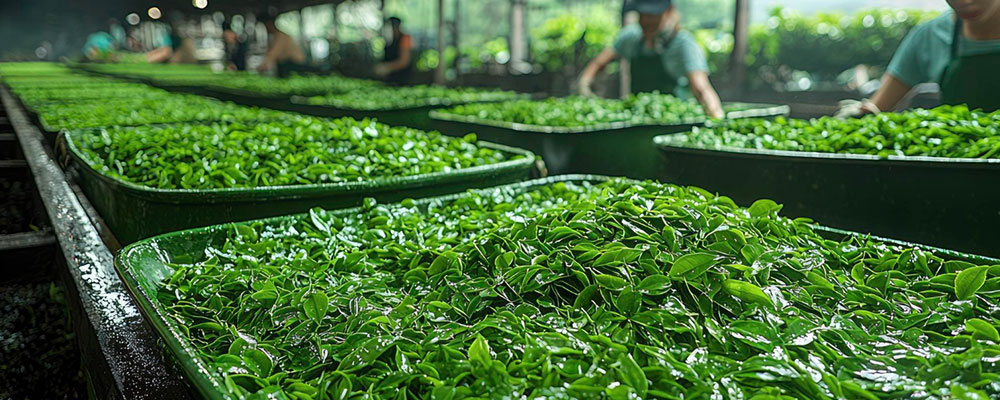
When appropriately designed and validated, enzyme-assisted processing can support several manufacturing objectives.
1. Improved Access to Intracellular Components
Cell-wall-degrading enzymes can help release compounds that may otherwise remain partially trapped within plant structures.
2. Better Extraction Efficiency
In extract and instant-tea applications, enzyme-assisted breakdown of structural polymers can improve the recovery of soluble material.
3. Controlled Development of Tea Pigments
Enzymatic treatment has been shown experimentally to influence the formation and balance of theaflavins, thearubigins and total liquor colour.
4. Potential Reduction in Residual Plant Material
Improved degradation of cell-wall components may reduce the amount of material remaining after extraction under suitable conditions.
5. Greater Process Flexibility
Application-specific enzyme formulations can provide processors with another variable for managing difficult raw materials or specific product requirements.
These benefits should always be confirmed through controlled industrial trials rather than assumed from enzyme activity data alone.
Quality Control and Validation at Commercial Scale
The transition from laboratory development to full-scale production is one of the most important stages in enzyme implementation.
A commercial evaluation should ideally establish a baseline using the existing manufacturing process. The enzyme system can then be evaluated against measurable parameters.
A practical validation programme may include:
- Characterising the raw tea material.
- Identifying the processing limitation.
- Selecting suitable enzyme activities.
- Establishing laboratory dosage and operating conditions.
- Conducting controlled production trials.
- Measuring chemical and physical quality parameters.
- Conducting sensory evaluation.
- Comparing extraction yield and process efficiency.
- Evaluating consistency over multiple production batches.
- Assessing the overall economic impact.
This approach helps distinguish genuine process improvements from changes caused by natural variation in the incoming tea material.
Broader Applications of Enzyme Technology Across Industries
The principles used in tea processing reflect a much wider industrial application of enzymes.
In dairy processing, enzymes such as lactase can hydrolyse lactose to support specialised dairy products, while other enzymes are used for targeted modifications in dairy manufacture.
In the detergent industry, proteases, amylases, lipases and cellulases target different categories of soils and can also contribute to fabric-care performance.
In textile processing, alpha-amylase is widely associated with desizing because it acts on starch-based sizing materials, while cellulase and other enzyme systems are used in selected finishing applications.
In animal feed, proteases support the hydrolysis of dietary proteins, while phytase, xylanase and beta-glucanase target other nutritional and anti-nutritional components.
In water treatment, biological and enzymatic processes can assist the breakdown of selected organic compounds and support integrated wastewater-management strategies.
In sugar mills, amylases can target starch while dextranase can address dextran-related viscosity challenges. In grain distilleries, alpha-amylase and glucoamylase support the conversion of starch into fermentable sugars through liquefaction and saccharification.
Across all these industries, the common principle is specificity: an enzyme is useful because it acts on a defined substrate under defined process conditions.
A More Scientific Approach to Tea Process Optimisation
The future of enzyme-assisted tea manufacturing is likely to involve increasingly precise formulations and better integration with process monitoring.
Instead of adding enzymes simply to accelerate a reaction, manufacturers can use analytical measurements to determine where a specific biochemical limitation exists and whether enzymatic intervention provides measurable value.
This could involve evaluating:
- Raw-leaf characteristics
- Cell-wall composition
- Enzyme accessibility
- Oxidation kinetics
- Extractability
- Pigment development
- Sensory quality
- Process yield
Recent research continues to explore the biochemical mechanisms behind flavour development and phenolic transformations during black tea processing, including the interactions between polyphenol oxidase, peroxidase and phenolic compounds.
This growing understanding can support more controlled use of enzyme technology in the future.
Choosing an Enzyme Partner for Tea Processing
For tea manufacturers, the selection of an enzyme supplier should extend beyond a product specification sheet.
Important considerations include:
- Enzyme activity and specificity
- Source and formulation characteristics
- Food-grade suitability
- Stability during storage
- Compatibility with the processing environment
- Technical support
- Application-development capabilities
- Ability to conduct trials
- Batch-to-batch consistency
A supplier with application knowledge can help determine not only which enzyme is appropriate, but also where it should be introduced, at what dosage and under which operating conditions.
Biolaxi Enzymes approaches tea processing through a dedicated pectinase-based formulation containing pectinase and hemicellulase. According to its published product information, the formulation is designed to assist cell-wall breakdown during tea processing and improve the release of intracellular compounds that contribute to liquor quality.
The importance of this approach lies in application specificity. Tea manufacturing is sensitive to raw-material and process variation, so the enzyme should be assessed according to the manufacturer’s actual processing objectives rather than as a generic additive.
Conclusion
Black tea quality is the result of a complex interaction between raw-leaf characteristics, cellular structure, endogenous enzymes and carefully controlled manufacturing conditions. The major biochemical transformation during black tea manufacture involves the oxidation of phenolic compounds, particularly catechins, into theaflavins and thearubigins that contribute to liquor colour, flavour and sensory character.
Exogenous enzyme technology provides an additional level of control by acting on specific components of the tea leaf. Pectinases, cellulases and hemicellulases can modify cell-wall structures and improve the accessibility of intracellular compounds, while carefully controlled oxidative enzyme systems can influence biochemical transformations during processing. Research has demonstrated that these interventions can affect extractability, tea pigments, total liquor colour and other quality parameters, although results depend strongly on dosage, enzyme combination and process conditions.
For manufacturers, the real value of enzyme technology lies in precision. The objective is not simply to increase enzymatic activity, but to identify a specific processing challenge and apply the appropriate biological catalyst under conditions that deliver a measurable improvement without compromising the desired cup profile.
Biolaxi Enzymes addresses this requirement through application-focused enzyme solutions, including a pectinase and hemicellulase formulation developed specifically for tea processing. Its published application information focuses on improving cell-wall breakdown, compound release and selected liquor-quality characteristics.
As tea manufacturers continue to pursue consistent quality, efficient extraction and greater control over processing variables, enzyme technology can serve as a valuable tool within a scientifically managed production system. The strongest results will come from combining enzyme expertise with detailed process understanding, analytical validation and careful control of the characteristics that ultimately define a high-quality black tea.