
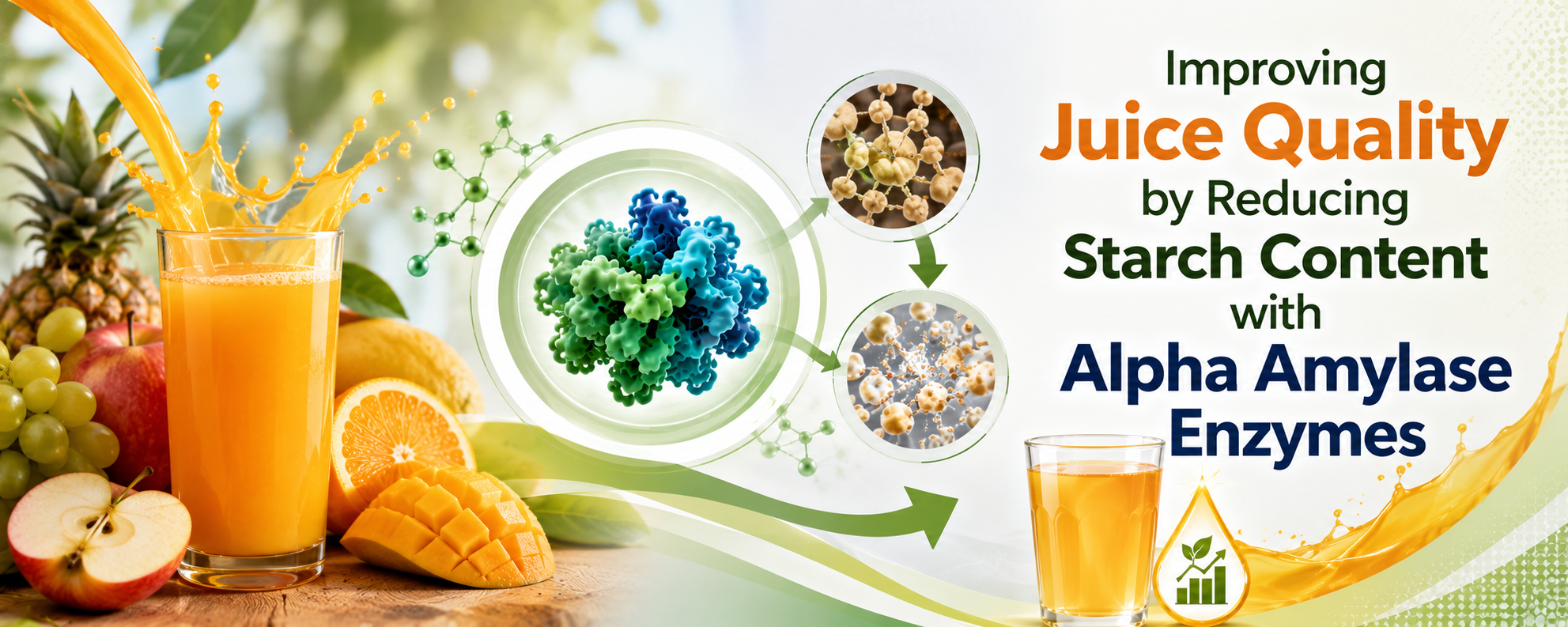
Consumer demand for premium fruit juices continues to grow as beverage manufacturers focus on delivering products with superior clarity, flavour, nutritional value and consistency. At the same time, processors face increasing pressure to improve production efficiency, maximise raw material utilisation and meet stringent quality standards while reducing operational costs. One of the recurring challenges in fruit juice production is the presence of residual starch, which can negatively affect juice appearance, filtration efficiency, shelf stability and overall product quality.
Industrial enzyme technology has become an essential solution to this challenge. Among the various enzymes used in fruit processing, alpha amylase plays a critical role in breaking down starch into smaller carbohydrate molecules, allowing manufacturers to improve juice clarification, enhance filtration performance and achieve more consistent processing outcomes. Rather than relying on aggressive physical or chemical treatments, enzyme-assisted processing provides a highly selective and efficient approach that preserves the natural characteristics of the fruit.
The success of alpha amylase in juice production reflects the broader importance of industrial enzymes across multiple manufacturing sectors. Similar technologies have transformed tea processing, commercial baking, dairy production, detergent formulation, textile processing, animal nutrition, wastewater treatment and sugar manufacturing by improving efficiency, product quality and sustainability.
This article explores the science behind starch reduction using alpha amylase, its contribution to juice quality, and the broader value of industrial enzymes across modern industries.
Understanding the Role of Starch in Fruit Juice Processing
Starch is a naturally occurring carbohydrate found in many fruits, particularly those harvested before full maturity. Fruits such as apples, bananas, mangoes, pears and certain tropical varieties may contain varying levels of starch depending on their stage of ripeness and growing conditions.
During juice extraction, residual starch can create several processing challenges.
These include:
- Increased turbidity
- Poor juice clarity
- Higher viscosity
- Slower filtration
- Reduced processing efficiency
- Sediment formation during storage
Even relatively small amounts of starch can influence the appearance and stability of the final product, making effective starch management an important aspect of industrial juice production.
What Are Alpha Amylase Enzymes
Alpha amylase is a hydrolytic enzyme that catalyses the breakdown of internal alpha-1,4 glycosidic bonds within starch molecules.
Rather than completely converting starch into simple sugars, alpha amylase reduces long-chain starch molecules into shorter dextrins and oligosaccharides, significantly lowering viscosity and improving downstream processing.
Commercial alpha amylase preparations are carefully formulated for industrial applications where controlled starch degradation is required without adversely affecting product quality.
The Science Behind Enzymatic Starch Reduction
The effectiveness of alpha amylase lies in its highly selective catalytic activity.
The process typically involves several stages.
1. Fruit Preparation
Fresh fruit is:
- Washed
- Sorted
- Crushed
- Converted into pulp or mash
At this stage, starch present within plant tissues becomes available for enzymatic treatment.
2. Enzyme Addition
Alpha amylase is introduced under carefully controlled operating conditions.
Critical processing variables include:
- Temperature
- pH
- Enzyme dosage
- Contact time
- Fruit composition
Optimising these parameters ensures maximum enzyme performance.
3. Starch Hydrolysis
The enzyme begins breaking long starch chains into smaller carbohydrate fragments.
As hydrolysis progresses:
- Viscosity decreases
- Starch concentration is reduced
- Juice becomes easier to process
- Clarification efficiency improves
4. Downstream Processing
Following enzymatic treatment, juice typically undergoes:
- Pressing
- Filtration
- Clarification
- Concentration (where required)
- Pasteurisation
- Packaging
Reduced starch levels improve the efficiency of each downstream operation.
How Alpha Amylase Improves Juice Quality
Industrial processors use alpha amylase because it contributes to multiple aspects of product quality.
1. Improved Juice Clarity
Residual starch is a major contributor to haze formation.
By reducing starch content, alpha amylase supports:
- Brighter appearance
- Improved transparency
- Enhanced consumer appeal
2. Lower Viscosity
Reduced viscosity improves:
- Pumping efficiency
- Heat transfer
- Mixing
- Equipment performance
These improvements contribute to smoother production operations.
3. Enhanced Filtration
Starch degradation allows filtration systems to operate more efficiently.
Benefits include:
- Faster filtration
- Improved throughput
- Reduced filter fouling
- Longer filter life
4. Improved Shelf Stability
Residual starch may contribute to sediment formation during storage.
Enzymatic treatment helps maintain:
- Stable appearance
- Consistent product quality
- Reduced precipitation
Operational Benefits for Juice Manufacturers
Beyond improving product quality, enzyme technology supports greater manufacturing efficiency.
1. Higher Production Efficiency
Enzyme-assisted processing often contributes to:
- Faster production cycles
- Improved equipment utilisation
- Reduced process interruptions
2. Better Raw Material Utilisation
Effective starch conversion enables manufacturers to maximise value from incoming fruit while reducing production losses.
3. Consistent Batch Quality
Industrial enzymes provide predictable performance when operating conditions are carefully controlled.
This improves:
- Product consistency
- Process repeatability
- Quality assurance
4. Reduced Resource Consumption
Improved processing efficiency may contribute to:
- Lower energy requirements
- Reduced water usage
- Better utilisation of processing equipment
Factors Influencing Enzyme Performance
Several processing conditions determine the effectiveness of alpha amylase during juice production.
1. Temperature
Each enzyme preparation performs within a specific temperature range.
Maintaining optimum temperatures maximises catalytic efficiency.
2. pH
The acidity of fruit juice directly influences enzyme activity.
Proper pH management helps achieve reliable starch hydrolysis.
3. Enzyme Dosage
Selecting the correct dosage balances processing efficiency with production economics.
4. Processing Time
Adequate reaction time ensures effective starch reduction while maintaining production throughput.
Applications Across the Fruit Beverage Industry
Alpha amylase technology supports processing across numerous fruit categories.
Applications include:
- Apple juice
- Mango juice
- Banana beverages
- Pear juice
- Tropical fruit blends
- Fruit concentrates
- Fruit purees
- Functional fruit beverages
Its versatility allows processors to optimise production across a broad range of formulations.
Sustainability Through Enzyme-Assisted Juice Processing
Sustainability has become a central objective for beverage manufacturers.
Enzyme technology contributes by supporting:
- Improved raw material utilisation
- Lower energy consumption
- Reduced process waste
- Improved production efficiency
- Better resource management
- Reduced environmental impact
These advantages align with broader environmental and operational excellence initiatives.
Industrial Enzymes Beyond Juice Production
The success of alpha amylase demonstrates the broader contribution of industrial enzymes across modern manufacturing industries.
Today, specialised enzymes improve productivity and product quality across numerous sectors.
1. Enzymes for Tea Processing
Tea production relies on carefully controlled biochemical transformations.
Industrial enzymes assist with:
- Controlled oxidation
- Flavour development
- Colour formation
- Aroma enhancement
- Improved processing consistency
These improvements help manufacturers maintain uniform product quality.
2. Enzymes for Baking
Commercial baking operations depend heavily on enzyme technology.
Applications include:
- Dough conditioning
- Increased loaf volume
- Improved crumb texture
- Better dough handling
- Extended freshness
- Improved production consistency
Enzymes help optimise manufacturing while reducing dependence on chemical improvers.
3. Enzymes for Dairy Processing
The dairy industry uses specialised enzymes throughout multiple production stages.
Applications include:
- Lactose hydrolysis
- Cheese manufacture
- Protein modification
- Texture optimisation
- Yield improvement
- Flavour enhancement
These technologies improve product consistency while increasing manufacturing efficiency.
4. Enzymes for the Detergent Industry
Modern detergents incorporate enzyme blends to improve cleaning performance.
Common enzymes include:
- Proteases
- Lipases
- Amylases
- Cellulases
Together, they remove:
- Protein stains
- Starch residues
- Oils
- Food deposits
- Dairy residues
These formulations provide effective cleaning while supporting lower-temperature washing.
5. Enzymes for the Textile Industry
The textile sector increasingly replaces traditional chemical treatments with enzyme-assisted processes.
Applications include:
- Desizing
- Bio-polishing
- Denim finishing
- Fabric softening
- Fibre preparation
Enzymes improve fabric quality while reducing chemical consumption and wastewater generation.
6. Enzymes for the Feed Industry
Feed enzymes improve nutrient availability by breaking down complex feed ingredients.
Benefits include:
- Improved digestibility
- Better feed conversion efficiency
- Reduced nutrient losses
- Enhanced livestock productivity
- More efficient feed utilisation
These improvements contribute to sustainable animal production systems.
7. Enzymes for Water Treatment
Industrial wastewater treatment increasingly incorporates specialised enzyme solutions.
Applications include:
- Organic matter degradation
- Biofilm control
- Sludge reduction
- Wastewater treatment
- Odour management
Enzyme-assisted treatment improves biological system performance while supporting environmental compliance.
8. Enzymes for Sugar Mills
Sugar manufacturers also benefit from industrial enzyme technology.
Applications include:
- Juice clarification
- Reduced viscosity
- Improved extraction efficiency
- Better filtration
- Increased sugar recovery
- Enhanced process stability
These improvements support higher productivity and improved operational performance.
Future Developments in Industrial Enzyme Technology
Biotechnology continues to advance rapidly, creating increasingly efficient industrial enzyme formulations.
Future developments are expected to focus on:
- Greater catalytic efficiency
- Improved enzyme stability
- Broader operating conditions
- Tailored enzyme blends
- Enhanced process automation compatibility
- Improved sustainability performance
These innovations will continue to expand the role of enzymes across food processing and industrial manufacturing.
The Strategic Value of Enzyme Technology in Food Processing
For modern food manufacturers, enzyme technology represents more than a processing aid it is a strategic tool for improving operational performance and product quality. Biological catalysts enable processors to optimise production while reducing reliance on resource-intensive methods and maintaining the natural characteristics of food products.
Key strategic advantages include:
- Improved manufacturing efficiency
- Greater product consistency
- Better utilisation of raw materials
- Reduced processing costs
- Enhanced sustainability performance
- Support for regulatory compliance
As consumer expectations and environmental standards continue to evolve, enzyme-assisted processing will remain a critical component of advanced food manufacturing.
Conclusion
Alpha amylase enzymes have become an essential component of modern fruit juice processing by enabling efficient starch reduction, improved clarification, enhanced filtration performance and greater product stability. Their highly selective mode of action allows manufacturers to preserve the natural flavour and quality of fruit while optimising production efficiency and maximising raw material utilisation. As beverage manufacturers continue to focus on quality, consistency and sustainable operations, enzyme-assisted processing offers a reliable and scientifically proven approach to achieving these objectives.
The benefits of industrial enzymes extend well beyond juice production. Similar technologies continue to enhance tea processing, baking, dairy manufacturing, detergent formulation, textile processing, animal nutrition, water treatment and sugar milling by improving operational efficiency, supporting product innovation and reducing environmental impact across diverse industries.
Biolaxi Enzymes supports these evolving industrial requirements through a comprehensive portfolio of specialised enzyme solutions developed for food processing and a wide range of industrial applications. By combining technical expertise, consistent product quality and application-focused innovation, Biolaxi Enzymes helps manufacturers overcome processing challenges, improve operational performance and achieve sustainable manufacturing outcomes across multiple sectors.