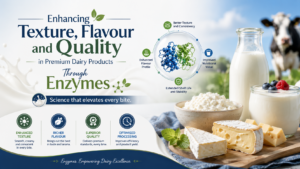

The dairy industry plays a crucial role in supplying nutrient-rich foods like milk, cheese, yogurt, and whey-based products. However, the processes involved in transforming raw milk into these diverse products are highly sensitive, requiring precision, quality control, and cost-effectiveness. Enzymes have emerged as indispensable tools that streamline dairy processing while meeting rising demands for functional, sustainable, and lactose-free dairy products. This article explores the key challenges facing the dairy industry, the benefits of using enzymes, and an in-depth look at all major enzymes used in dairy processing.
Industry Challenges and How Enzymes Provide Solutions
The dairy industry encounters several technical, environmental, and consumer-driven challenges. These include the need for consistent product quality, reduced processing times, low lactose or lactose-free options, enhanced flavor profiles, and sustainable operations. Traditional physical and chemical treatments often fall short, leading to high energy consumption, variable results, or negative impacts on product quality.
Enzymes offer a precise and natural alternative. Their specificity enables targeted biochemical reactions without affecting other components. Enzymes work under mild conditions, which preserves nutrients and reduces energy costs. They are used across every step of dairy processing, from milk clarification to flavor enhancement in aged cheeses and protein hydrolysis in nutritional formulations. This not only improves operational efficiency but also addresses evolving dietary preferences and regulatory pressures for cleaner labels.
Benefits of Using Enzymes in the Dairy Industry
- Improve yield and consistency in cheese production
- Enable production of lactose-free and low-lactose dairy products
- Enhance flavor and texture in cheese and yogurt
- Increase shelf life and microbial stability of dairy products
- Support clean-label formulations with minimal additives
- Improve digestibility and nutritional profile of dairy proteins
- Allow recovery and reuse of valuable by-products like whey proteins
- Reduce environmental impact through efficient processing
- Enable customization for local tastes and dietary needs
Enzymes Used in Dairy Processing
Below is a comprehensive explanation of all major enzymes used in dairy processing, including how they function, where they are applied, and the final products they help produce.
-
Rennet (Chymosin and Pepsin)
Rennet is a complex of enzymes primarily containing chymosin, used for coagulating milk in cheese-making. It is traditionally sourced from the stomachs of calves but is now widely produced through microbial fermentation to meet vegetarian and large-scale production demands. Chymosin specifically cleaves the kappa-casein in milk, destabilizing casein micelles and causing curd formation.
This enzymatic action separates milk into curds and whey, a critical first step in making hard and semi-hard cheeses such as cheddar, mozzarella, gouda, and Parmesan. Pepsin is often present in smaller quantities and assists in proteolysis, particularly in aged cheeses.
Modern cheese production has benefited from fermentation-produced chymosin (FPC), which ensures purity, consistency, and availability without relying on animal-derived sources. Rennet’s effectiveness depends on factors such as pH, temperature, and milk composition. In addition to enabling curdling, it helps determine moisture retention and the final cheese texture. With precise dosing, rennet allows consistent batch production, reduces waste, and supports both artisanal and industrial-scale cheese manufacturing.
-
Lactase (β-Galactosidase)
Lactase is the enzyme responsible for breaking down lactose, the disaccharide sugar found in milk. This hydrolysis results in the production of glucose and galactose, two simpler sugars that are easily digested. This enzyme is vital for producing lactose-free or low-lactose dairy products, essential for the growing population with lactose intolerance.
Derived from microbial sources like Kluyveromyces lactis and Aspergillus oryzae, lactase is introduced either during milk processing or after packaging. In milk, ice cream, yogurt, and flavored dairy drinks, the enzyme reduces lactose content and improves sweetness, allowing for reduced added sugar content.
Lactase also prevents crystallization in products such as condensed milk and frozen desserts, where unbroken lactose can form gritty textures. Industrial applications use immobilized lactase systems for continuous production. Overall, lactase improves product quality and broadens market reach while supporting consumer health.
-
Lipase
Lipase is an enzyme that catalyzes the hydrolysis of milk fats into free fatty acids and glycerol. It is crucial in cheese manufacturing for developing characteristic flavors, particularly in aged and Italian-style cheeses like blue cheese, provolone, and Romano.
Sourced from microbial organisms like Mucor miehei or from animal tissues, lipase is added during cheese fermentation to accelerate the ripening process. It contributes to piquancy and aroma by releasing short- and medium-chain fatty acids, including butyric, caproic, and caprylic acids.
Lipase activity must be tightly controlled to prevent rancidity. Cheese varieties that undergo accelerated ripening use tailored lipase blends to mimic traditional flavor profiles in less time. Lipase is also being explored in dairy flavorings and cream-based sauces. Its role is purely sensory, with no contribution to coagulation or yield. When used correctly, it enhances product differentiation and market appeal.
-
Protease
Proteases are enzymes that hydrolyze peptide bonds in proteins. In dairy processing, they are used for several purposes including cheese ripening, protein hydrolysis for nutritional supplements, and flavor enhancement. Sources include fungal (Aspergillus oryzae), bacterial (Bacillus subtilis), and plant-based (papain, bromelain) enzymes.
In cheese maturation, proteases break down casein into peptides and amino acids, contributing to texture softening and flavor development. In infant formulas and sports nutrition, proteases are used to create hydrolyzed proteins that are easier to digest and less allergenic.
Different proteases exhibit varying specificity, allowing for controlled proteolysis. For instance, endoproteases cleave internal peptide bonds, while exoproteases act on terminal residues. Dairy technologists select enzyme blends based on desired texture, flavor intensity, and nutritional profile. Proteases also enable production of clear whey protein drinks and functional dairy beverages.
-
Transglutaminase
Transglutaminase (TGase) is an enzyme that catalyzes the formation of covalent bonds between glutamine and lysine residues in proteins. This cross-linking results in improved gel strength, water-holding capacity, and product stability.
Microbial TGase from Streptomyces mobaraensis is commonly used in dairy applications. It enhances the texture and viscosity of yogurt, improving spoonability and reducing whey separation. In processed cheeses, it helps bind protein structures, improving sliceability and melt behavior.
TGase is also used in high-protein milk beverages and desserts to improve mouthfeel without relying on synthetic thickeners or stabilizers. It is added post-pasteurization and activated during incubation. Importantly, TGase does not introduce foreign residues, making it suitable for clean-label formulations.
-
Catalase
Catalase is an enzyme that breaks down hydrogen peroxide into water and oxygen. It is widely used in dairy processing to remove residual hydrogen peroxide used during cold pasteurization or aseptic packaging.
Derived from bovine or microbial sources, catalase ensures safety by eliminating peroxide, which can otherwise degrade product quality or interfere with fermentation cultures. It is particularly important in infant formula production and in operations where peroxide sterilization is part of the packaging process.
Catalase is fast-acting, safe, and leaves no harmful residues. It protects flavor, color, and nutrients while ensuring compliance with food safety regulations.
-
Glucose Oxidase
Glucose oxidase is an enzyme that catalyzes the oxidation of glucose to gluconic acid and hydrogen peroxide, effectively removing oxygen from the environment. This helps extend the shelf life of dairy products by inhibiting oxidation and microbial spoilage.
Commonly used in conjunction with catalase, glucose oxidase is applied in milk powders, cream, and fermented dairy where oxygen exposure can affect flavor and stability. It is also used in packaging systems to create low-oxygen environments.
By reducing oxygen levels, glucose oxidase minimizes fat rancidity and pigment degradation. It also protects probiotic cultures during storage, improving the viability of live bacteria in functional dairy products.
-
Lysozyme
Lysozyme is an antimicrobial enzyme that hydrolyzes the cell walls of gram-positive bacteria. In dairy, it is used to prevent the growth of unwanted lactic acid bacteria in cheese and to extend shelf life.
Naturally found in egg whites and also available from microbial sources, lysozyme is especially useful in preventing late blowing in hard cheeses like Emmental and Gouda, which is caused by Clostridium tyrobutyricum.
It is added to milk or curd during cheese making and remains active throughout aging. Lysozyme contributes to consistent texture, flavor, and structural integrity by preventing gas formation and spoilage.
-
Peroxidase
Peroxidase is used in the dairy industry primarily as an indicator enzyme to verify proper pasteurization. It catalyzes the oxidation of substrates in the presence of hydrogen peroxide. When milk is adequately heat-treated, peroxidase becomes inactive, so its absence serves as a sign of successful pasteurization.
It is not typically used to directly alter milk or cheese but plays a critical quality control role. In some dairy systems, peroxidase is also used to study oxidation-reduction potential and enzyme activity. Its presence or absence helps technicians monitor thermal processing efficacy and maintain product safety standards.
-
Naringinase
Naringinase is an enzyme complex that hydrolyzes naringin, a bitter compound occasionally introduced into dairy blends via plant-based ingredients. This enzyme enhances flavor by removing bitterness without affecting the nutritional value of the product.
Though not used in all dairy operations, naringinase is valuable in niche dairy beverages that include fruit extracts or botanicals, especially in probiotic or health-oriented drinks. It ensures taste neutrality and improves consumer acceptance for specialty dairy products.
-
Amylase (α-Amylase)
Amylases are enzymes that hydrolyze starch into smaller sugar units. In dairy, α-amylase can be used when dairy products include starchy ingredients, such as flavored milk with added thickeners or desserts like custards and puddings.
This enzyme helps prevent undesired viscosity, ensuring product consistency. Amylase is also used in the preparation of feed-grade dairy by-products, where carbohydrate breakdown is necessary for digestibility enhancement.
-
Cellulase
Cellulase breaks down cellulose and is occasionally used in dairy-based beverages or blends containing plant fibers. While not directly acting on milk, cellulase supports texture and smoothness in fiber-rich functional drinks, which include dairy as a base.
This enzyme enables better dispersion of fiber, improving palatability and mouthfeel. It is especially relevant in fortified dairy beverages targeting gut health and fiber enrichment.
-
Xylanase
Xylanase breaks down hemicellulose, particularly xylan, found in plant-based additives. Like cellulase, it is used in functional dairy beverages or hybrid products combining milk with grain or nut-based ingredients.
It contributes to reducing viscosity, improving clarity, and enhancing stability in such blended products. Xylanase plays a supporting role in dairy innovation where traditional and plant-based components intersect.
-
Urease
Urease hydrolyzes urea into ammonia and carbon dioxide. In dairy, it is occasionally used in milk quality testing and in certain fermentation systems to eliminate urea, which can otherwise interfere with microbial stability or product taste.
Its use is more specialized but beneficial in cases where precise fermentation control is essential, such as in fermented milk-based beverages or scientific dairy trials.
-
Papain/Bromelain (Plant Proteases)
Papain (from papaya) and bromelain (from pineapple) are plant-derived proteolytic enzymes used in the hydrolysis of milk proteins. They are especially relevant in the production of hypoallergenic infant formulas, protein hydrolysates, and nutritional supplements.
These enzymes help create peptides of desired lengths and reduce allergenicity while maintaining nutritional value. Their gentle action ensures minimal sensory alteration, making them suitable for sensitive or medical nutrition products derived from milk.
Conclusion
Enzymes have revolutionized dairy processing by providing precise, sustainable, and health-conscious solutions. From enabling lactose-free products and improving cheese yield to extending shelf life and developing functional beverages, enzymes address the multifaceted needs of today’s dairy industry. Their targeted actions enhance product quality, reduce waste, and support innovation while aligning with global trends in nutrition, health, and sustainability.